
NIT Rourkela Develops Lightweight Nanocomposite to Enhance Aircraft Landing Gear Durability
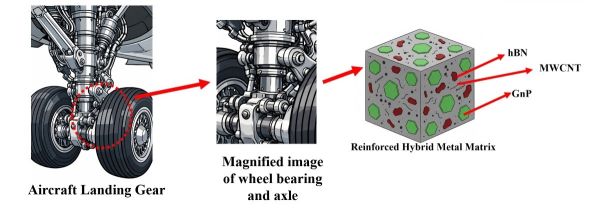
Rourkela, Apr30 (TNT): A research team at National Institute of Technology (NIT) Rourkela has developed a lightweight and highly durable nanocomposite material that could significantly enhance aircraft landing gear performance, offering improved wear resistance and cost efficiency.
Aircraft landing gear, typically made from aluminium and its alloys, must withstand extreme stress during landing and taxiing.
While lightweight, these materials often face durability challenges under high-load conditions, the Institute said in a release here on Thursday.
To address this, the team led by Syed Nasimul Alam, Associate Professor in Metallurgical and Materials Engineering, developed a novel aluminium-based hybrid nanocomposite.
The research involved contributions from scholars including Dr. Arka Ghosh, Dr. Ashutosh Das, Dr. Pankaj Shrivastava, Mr. Nityananda Sahoo, Mr. Parth Patel, and Dr. Velaphi Msomi of the University of South Africa.
The study, published in the journal ‘Materials Letters’, utilised carbon nanotubes to enhance compressive strength and load-bearing capacity, along with graphite nanoplatelets and hexagonal boron nitride to improve thermal stability and durability.
High-frequency sound waves were used to ensure uniform dispersion of particles within the aluminium matrix.
The resulting material, produced through high-pressure compaction and heating in an oxygen-free environment, demonstrated superior strength, toughness and wear resistance.
Researchers noted that the nanocomposite forms a three-dimensional reinforcing network that improves load transfer and structural stability while significantly reducing surface wear.
The material holds potential applications in defence aircraft and unmanned aerial vehicles (UAVs), where lightweight and durability are critical.
According to the researchers, it could offer 40–60 per cent higher cost-effectiveness compared to conventional materials such as ultra-high-strength steels and titanium alloys.
The team is now working on scaling up the technology to develop larger components using powder metallurgy techniques.
The innovation aligns with India’s Atmanirbhar Bharat initiative and could position the country as a contributor to next-generation aerospace materials.
TNT TS