
Hyd: IGBC marks 25 years of advancing India’s green building movement
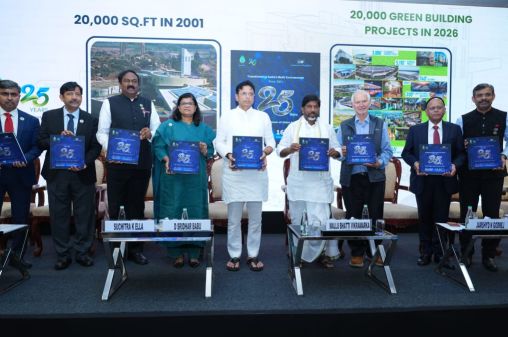
Hyderabad, Aug 31 (TNT) : The Indian Green Building Council (IGBC), part of the Confederation of Indian Industry (CII), on Monday marked 25 years of advancing India’s green building movement, with senior government and industry leaders calling for sustainability to become a standard feature of the country’s development.
Established by CII in 2001, IGBC has helped mainstream green building practices in India.
The council now has 20,012 registered green building projects covering more than 16.33 billion sq ft under 33 Green and Net Zero rating systems.
The portfolio includes around 41 lakh residential dwelling units, more than 11,770 commercial projects, over 1,320 transit infrastructure projects, 985 industrial buildings, 271 registered Net Zero projects and more than 190 built-environment projects.
The Silver Jubilee celebrations in Hyderabad brought together senior representatives from the government, industry and the green building movement to reflect on IGBC’s 25-year journey and discuss priorities for sustainable and Net Zero development.
Deputy Chief Minister of Telangana Mallu Bhatti Vikramarka, who attended as chief guest, said sustainability must remain at the core of Telangana’s rapid economic and infrastructure growth.
“As Telangana pursues rapid economic and infrastructure growth, sustainability must remain at its core. We are scaling up renewable energy and working towards a future where our buildings, industries and data centres are powered by clean energy,” he said.
He said sustainable infrastructure should be accessible to cities as well as Tier-II towns and rural communities and should not be treated as a luxury.
“We look forward to partnering with IGBC to make green construction more affordable, scalable and inclusive, and to position Telangana as a model for green and resilient growth,” he added.
Telangana Minister for IT, D. Sridhar Babu, who attended as guest of honour, said IGBC had helped transform sustainability from a choice into a standard practice.
As Telangana emerges as a global hub for technology, artificial intelligence and advanced industries, sustainability would be central to its growth, with clean energy, water security and resource-efficient infrastructure becoming increasingly important, he said.
The CII–Sohrabji Godrej Green Business Centre in Hyderabad is closely associated with IGBC’s journey.
Inaugurated by then President of India Dr A.P.J. Abdul Kalam in July 2004, it was India’s first Platinum-rated green building and achieved Net Zero Energy status in 2019.
IGBC said its assessments indicate average savings of about 35 per cent in carbon emissions, 40 per cent in water use, 50 per cent in energy use and 70 per cent in solid waste.
The council’s Net Zero Mission, launched in 2021, has attracted commitments from more than 350 organisations. IGBC has recorded over 155 Net Zero Certified Projects, while more than 271 projects covering around 298.4 million sq ft are registered under the programme.
CII Green Business Centre Chairman Jamshyd Godrej said IGBC had demonstrated that environmental responsibility and business value could go hand in hand.
“IGBC has helped create a strong foundation for India’s green building movement. We started by demonstrating that green buildings were possible. The next challenge is to make a greener way of building the normal way of building,” he said.
He called for greater innovation, stronger policy support and wider industry adoption, with IGBC continuing to serve as a catalyst for collaboration.
As part of the silver jubilee celebrations, a 25-year commemorative video film documenting the evolution of the green building movement and IGBC’s milestones since 2001 was released.
An IGBC@25 memoir dossier documenting the council’s journey and contribution to green and Net Zero development was also released.
CII President Designate Dr Suchitra K. Ella said IGBC had transformed sustainability from a desirable addition to development into a prerequisite for growth, resilience and competitiveness.
She said the next 25 years should be defined by regenerative innovation, technology-enabled sustainability and collaborative leadership.
IGBC’s programmes now extend beyond buildings to railways, mass rapid transit, high-speed rail, cities, townships, villages, logistics, healthcare and industry.
The council has worked with more than 2,800 government projects, trained over 60,000 professionals and operates through 32 local chapters across India.
Thirteen State Governments have introduced incentives for IGBC-certified projects.
IGBC National Chairman C. Shekar Reddy said the council had evolved from an emerging green-building initiative into a nationwide movement involving thousands of stakeholders who believe India’s economic growth should be sustainable.
National Vice Chairman A.R. Unnikrishnan said the green building movement had fundamentally changed the way India approached the built environment, with sustainability increasingly integrated into materials, design, energy, water, waste, carbon and occupant well-being.
The council said its next phase would focus on scaling green and Net Zero practices across the built environment and making sustainable development a standard feature of India’s growth as cities, housing, manufacturing, transportation and infrastructure expand.
TNT TS