BRICS Anti-Corruption Working Group Meeting Begins in Hyderabad
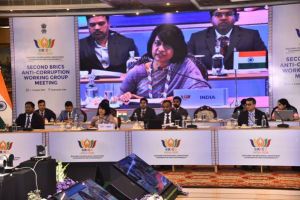
Hyderabad, Aug. 4 (TNT): The two-day Second BRICS Anti-Corruption Working Group (ACWG) Meeting commenced in Hyderabad on Tuesday, with member countries deliberating on strengthening international cooperation to combat corruption, trace fugitive economic offenders and recover illicit assets.
The meeting, being held on August 4 and 5, also includes the Second Meeting of the BRICS Expert Network on Asset Recovery.
Addressing after inaugurating the meeting, Rachna Shah, Secretary, Department of Personnel and Training (DoPT), said corruption remains a major obstacle to sustainable and inclusive development as it diverts public resources from essential sectors such as healthcare, education and infrastructure while eroding public trust.
She said no country is immune to corruption and stressed that tackling the menace requires coordinated international cooperation to prevent illicit financial flows, safeguard public resources and strengthen the global anti-corruption framework.
Noting that the meeting comes at a crucial time, Shah said BRICS countries should translate their shared commitment to combating cross-border corruption into practical cooperation and measurable outcomes.
Highlighting the challenge posed by fugitive economic offenders, she called for stronger collaboration among member countries to trace offenders, facilitate extradition, recover stolen assets and plug loopholes enabling the cross-border movement of criminals and illicit funds.
The Secretary welcomed progress on the proposed BRICS Repository on Informal Cooperation for Tracing Fugitive Offenders Sought for Corruption and Supporting Extradition, as well as discussions on establishing a BRICS Network of Law Enforcement Practitioners to enhance cooperation in extradition-related matters.
She also welcomed the operationalisation of the BRICS Expert Network on Asset Recovery, saying the creation of a standardised information-sharing template and directory of contact points would improve coordination among law enforcement agencies.
Emphasising technology-driven governance, Shah said digital identity systems, electronic service delivery, digital payments and transparent procurement platforms can significantly reduce corruption by improving accountability and public scrutiny.
She cited initiatives such as the Government e-Marketplace (GeM), the Direct Benefit Transfer (DBT) programme, faceless and paperless taxation systems, technology-enabled vigilance and data-driven monitoring as examples of reforms promoting transparency.
The two-day programme includes discussions on cooperation in tracing fugitive offenders, strengthening asset recovery mechanisms, ethical governance through technology-driven systems and addressing the misuse of financial technology (FinTech) and virtual digital assets (VDAs) for concealing and laundering proceeds of corruption.
Earlier, J. Ashok Kumar, Chair of the BRICS Anti-Corruption Working Group, welcomed the participating delegations and said the progress achieved in recent months reflected the shared commitment of BRICS countries to enhancing anti-corruption cooperation through practical mechanisms while avoiding duplication of existing initiatives.
TNT TS