NIT Rourkela Develops Lead-Free Materials for Safer Lighting, Anti-Counterfeiting
The bismuth-based materials change their light-emission properties in response to heat and moisture, offering potential alternatives to lead-based photoluminescent compounds that raise environmental and health concerns because of lead toxicity.
The findings have been published in the Journal of Materials Chemistry C, the Institute said in a release on Wednesday.
The researchers found that the developed material loses water trapped within its structure when heated and emits blue light under ultraviolet (UV) exposure. When moisture returns, it absorbs water and the blue emission disappears.
The process is reversible, allowing the material’s optical properties to change with surrounding conditions.
The research was co-authored by Prof Saroj L Samal and research scholar Subhasish Sahoo of NIT Rourkela, along with Prof Parameswar K Iyer and Chakali Srinivas of IIT Guwahati, Rajanikanta Rana of IIT Bombay, and Prof Himansu S Biswal and Laxmipriya Dash of NISER Bhubaneswar.
Prof Samal said the bismuth-based organic-inorganic hybrid halide compound was synthesised using relatively inexpensive, environmentally friendly constituents through a simple process. Its ability to undergo reversible structural changes in response to heat and moisture, accompanied by changes in light emission, was a key feature of the material.
The technology could be used in anti-counterfeiting applications, including security inks for certificates, signatures and product labels.
The materials’ response under UV light after controlled heating could help verify the authenticity of documents and products.
Their sensitivity to moisture could also be explored for humidity monitoring in food packaging, storage facilities and other settings where moisture control is important.
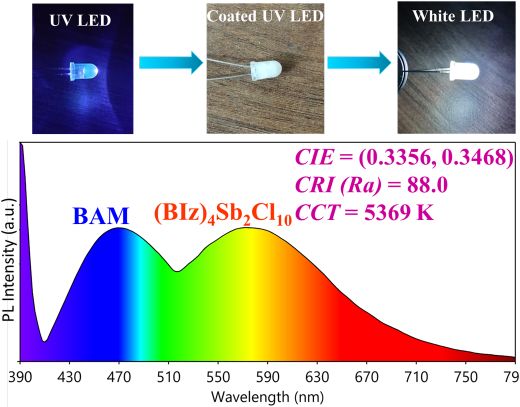
In a related development, the team has produced lead-free materials capable of emitting yellow light under UV exposure. By combining the material with a commercially available blue-light-emitting compound, the researchers developed a white-light-emitting diode with a cool, daylight-like appearance.
The system maintained stable light emission during continuous operation, indicating potential for solid-state lighting and light-conversion applications.
Prof Samal said the materials showed promise for reversible luminescence switching, moisture sensing, solid-state lighting and anti-counterfeiting applications.
The team plans to improve their light-emission efficiency and long-term stability and explore their integration into practical devices. Further work will focus on developing responsive luminescent materials for optical security, improving sensor sensitivity and reliability, and optimising white-light-emitting diodes, the release added.