Specialised adjudicatory institutions vital for complex regulatory disputes: Telangana HC CJ
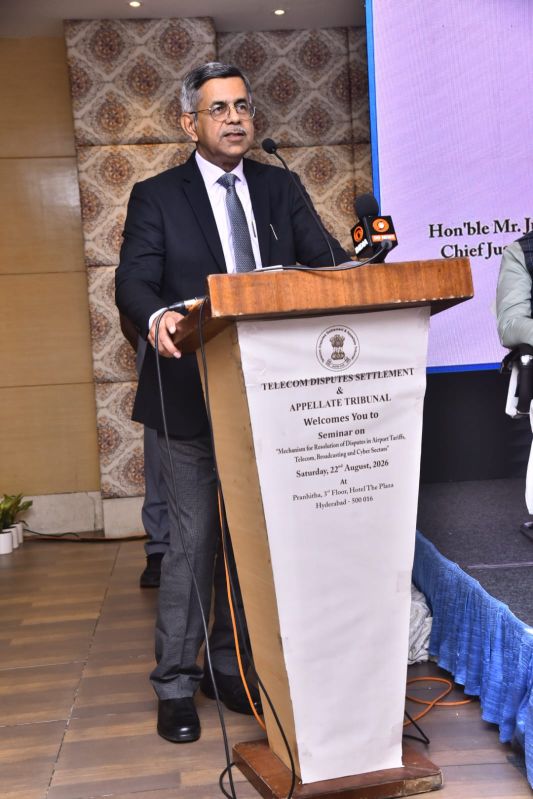
Hyderabad, Aug 22 (TNT): Telangana High Court Chief Justice Aparesh Kumar Singh on Saturday stressed the growing importance of specialised adjudicatory institutions in resolving technically complex regulatory disputes in sectors such as telecom, broadcasting, airport tariffs and cyber technologies.
Addressing a seminar on contemporary legal and regulatory issues with a focus on TDSAT, airport economic regulation, cyber law and broadcasting in the digital age, organised by the Press Information Bureau (PIB) here, Justice Aparesh Kumar said liberalisation of the telecom sector and entry of private players had necessitated new regulatory and adjudicatory frameworks.
He noted that the establishment of the Telecom Regulatory Authority of India (TRAI) in 1997 and the Telecom Disputes Settlement and Appellate Tribunal (TDSAT) in 2000 were important milestones in the evolution of specialised dispute resolution.
The Chief Justice said TDSAT’s jurisdiction had subsequently expanded to broadcasting, cable services and airport tariff matters.
He emphasised the need to strike a balance between regulatory autonomy, specialised expertise and judicial accountability, cautioning that prolonged litigation could undermine regulatory objectives and create uncertainty for industry and consumers.
Referring to the Supreme Court’s judgment in L. Chandra Kumar v. Union of India, Justice Aparesh Kumar said tribunals complemented the judicial system while remaining subject to constitutional judicial scrutiny.
On airport economic regulation, he said airports constituted complex economic ecosystems involving multiple stakeholders and interconnected services, with TDSAT playing an important role in resolving related tariff disputes.
In the telecom and broadcasting sectors, he highlighted issues relating to licensing, spectrum, interconnection, quality of service, access to signals and pricing.
Effective regulation, he said, should protect consumer interests while ensuring fair competition and a stable business environment.
Justice Aparesh Kumar also flagged emerging challenges in cyber and artificial intelligence, noting that rapid technological developments had increased the complexity of cyber disputes, fraud and questions of accountability.
While technology and AI could assist adjudicatory processes, they could not replace judicial reasoning, accountability and human oversight, he said.
He also emphasised mediation and consensual settlement in specialised disputes and supported wider availability of tribunal benches to improve access to specialised adjudication.
In his opening remarks, TDSAT Chairperson Justice D N Patel highlighted the tribunal’s role in providing specialised and time-bound dispute resolution across the telecom, broadcasting, airport tariff and cyber sectors.
Justice Patel stressed the need for greater awareness among policymakers, regulators, industry and legal professionals about the available dispute-resolution mechanisms.
On cyber disputes, he said that under the Information Technology Act, claims for compensation up to Rs 5 crore are initially adjudicated by the designated adjudicating officer, with TDSAT serving as the appellate forum.
Claims exceeding Rs 5 crore fall outside the jurisdiction of the designated adjudicating officer and are dealt with by the competent civil court, he said.
Telangana High Court Bar Association President S Surender Reddy, Advocate General A Sudershan Reddy and High Court Judge Justice P Sam Koshy were also present.
The seminar brought together members of the judiciary, legal professionals, regulators and other stakeholders to discuss strengthening dispute-resolution mechanisms in sectors undergoing rapid technological and regulatory change.
TNT TS