
India’s Space Economy to Reach USD 40-45 Billion in Less Than a Decade: Jitendra Singh
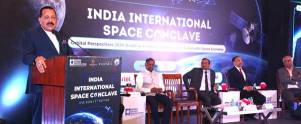
Singh said the establishment of New Space India Limited (NSIL), followed by the creation of IN-SPACe and the opening up of the space sector to private participation, had transformed the country’s space ecosystem and enabled private enterprises to enter an area traditionally dominated by the government.
Referring to the achievements of domestic startups, he cited Skyroot and Agnikul for their progress in developing launch vehicles, propulsion systems and advanced rocket technologies, besides growing capabilities in earth observation and satellite imaging.
He said the economic contribution of space technology should be assessed not only through rocket launches, satellite manufacturing and commercial revenues but also through savings, improved efficiency and better outcomes across sectors.
Space-based applications were helping improve infrastructure planning, reduce project costs, minimise wastage and ensure timely execution of projects under initiatives such as the PM Gati Shakti National Master Plan, he said.
Highlighting the wider applications of space technology, Singh said it had significant potential in infrastructure, construction, communications, education, healthcare, railways and defence.
On expanding demand for the space industry, he said greater awareness of the practical applications of space technology was necessary to unlock its commercial potential.
He said technological sovereignty and international cooperation were not contradictory, adding that India should strengthen indigenous capabilities while remaining open to mutually beneficial global partnerships.
Referring to the National Quantum Mission launched in 2023, Singh said India had achieved 1,000 km in secure quantum communication within three years, against the original target of 2,000 km over eight years.
He said space, quantum technologies, semiconductors and nuclear science were interconnected areas offering significant opportunities for technological advancement and commercial growth.
The Union Minister urged domestic private companies to increase investments in the space sector and facilitate greater overseas investment into India’s growing space ecosystem.
He also highlighted the role of the Anusandhan National Research Foundation and the Research, Development and Innovation Fund in strengthening research and encouraging private sector participation.
Calling for greater corporate support for scientific research, Singh urged industry leaders to channel more Corporate Social Responsibility (CSR) funds towards research and scientific development.
He also called for exploring international space innovation alliances, startup accelerator programmes and global innovation challenges to strengthen India’s position in the global space ecosystem.
ISRO Chairman and Department of Space Secretary V Narayanan, IN-SPACe Chairman Pawan Kumar Goenka and Indian Space Association Director General Lt Gen Anil Kumar Bhatt (Retd) were among those present.