India effectively free from Naxalism, no District left LWE-affected
New Delhi, Nov 24 (TNT) : India has achieved the milestone of becoming effectively free from Left-Wing Extremism (LWE), with no district in the country remaining Naxal-affected, following a comprehensive strategy combining security operations, infrastructure development, rehabilitation of surrendered cadres and tribal welfare.
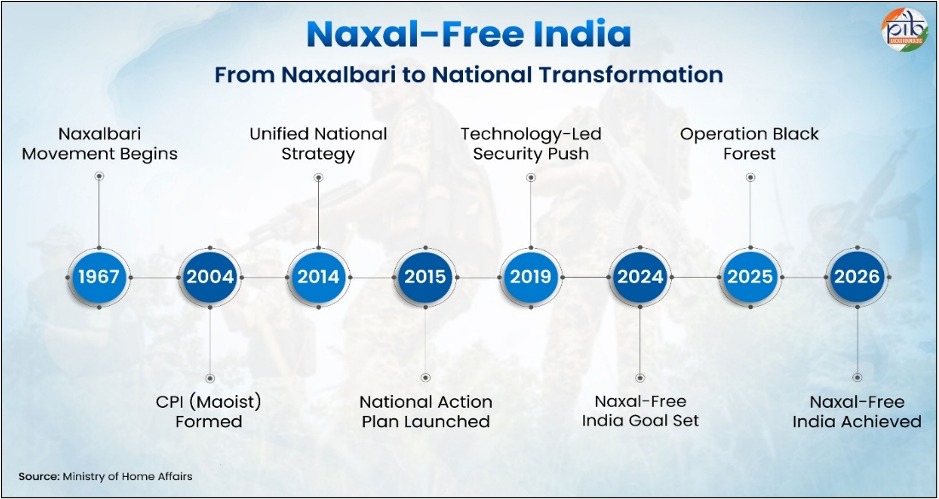
According to a Press Information Bureau (PIB) backgrounder released on Tuesday, the country achieved the target of becoming Naxal-free by March 31, 2026, set by the Union Government on August 24, 2024.
The number of LWE-affected districts declined from 126 in 2014 to zero by March-April 2026, while the number of most affected districts also came down from 35 to zero.
The government attributed the achievement to a coordinated approach involving security operations, improved connectivity, welfare delivery and better governance in remote tribal regions.
The decade between 2004 and 2014 witnessed 17,542 incidents of violence, resulting in 1,913 security personnel and 5,019 civilian deaths. Violence peaked in 2010 with 1,936 incidents.
In contrast, Naxal-related incidents declined from 870 in 2014 to 33 in 2026, while fatalities came down from 310 to 12, as on July 29, 2026.
As part of strengthening the security network, 668 security camps and 615 fortified police stations were established.
Besides, 68 night-landing helipads were constructed to facilitate rapid deployment of security forces in remote areas.
The government also intensified operations against Maoist networks through coordinated campaigns, including Operation Black Forest, Operation Octopus, Operation Double Bull and Operation Thunderstorm. Since 2014, a total of 41 Politburo and Central Committee members of CPI (Maoist) have been neutralised.
The rehabilitation initiative also encouraged extremists to surrender and return to the mainstream. Around 8,526 Naxalites laid down their arms till November 2026.
Under the rehabilitation policy, surrendered cadres are provided financial assistance, a monthly stipend for 36 months and additional incentives, besides support for skill development and livelihood opportunities.
Infrastructure development has been another major component of the strategy. As many as 15,189 km of roads were constructed under special schemes for LWE-affected areas, while 9,561 mobile towers were commissioned to improve telecommunications connectivity.
Banking infrastructure was also expanded with the opening of 1,804 bank branches, installation of 1,321 ATMs and establishment of 6,025 post offices between April 2015 and March 2026.
In the education sector, 259 Eklavya Model Residential Schools were sanctioned, of which 179 became functional.
Further, 47 Industrial Training Institutes and 49 Skill Development Centres were established, benefiting tribal youth and women.
The government also distributed more than 21.26 lakh title deeds under the Forest Rights Act to strengthen the rights of tribal communities.
The PIB backgrounder said the next phase would focus on consolidating the security gains, preventing a resurgence of extremism, rehabilitating affected communities and ensuring sustained development and delivery of welfare schemes.
It said the transformation marked not merely the end of an insurgency but the beginning of a new phase of peace, inclusion and development in some of the country’s most vulnerable regions.
TNT KM