Indian researchers develop new method to improve ionosphere modelling over India
New Delhi, July 8 (TNT): Researchers from the Indian Institute of Geomagnetism (IIG) have developed a novel method to reconstruct the topside ionosphere over the Indian region by integrating ground-based and space-based observations, a breakthrough expected to improve satellite operations, communication systems and navigation services.
The study marks the first time such an approach has been used to model the topside ionosphere over India, addressing a long-standing limitation in accurately representing the electron density profile in the upper atmosphere.
The ionosphere, an ionised layer of the Earth’s upper atmosphere, plays a crucial role in radio wave propagation, long-distance high-frequency communication and satellite-based navigation systems such as GPS and India’s NavIC.
Variations in electron density can significantly affect the accuracy of communication and navigation services.
The researchers noted that accurate information on electron density up to an altitude of around 1,000 km is essential for monitoring the ionosphere, as most Low Earth Orbit (LEO) satellites operate within this range.
Conventional ionospheric models generally assume a constant topside scale height because of the lack of reliable regional observations, particularly over India, resulting in inaccuracies in modelling the topside ionosphere.
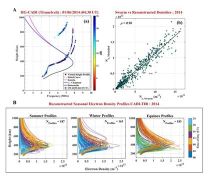
To overcome this limitation, the research team combined altitudinal variations of the topside scale height derived from COSMIC radio occultation measurements with bottomside ionosonde observations to generate a more realistic representation of the topside electron density profile.
According to the researchers, the new approach significantly improves the reconstruction of the topside ionosphere and provides more accurate, region-specific estimates of the topside scale height gradient, particularly over the geomagnetic equator where ionospheric behaviour is highly complex.
The study, carried out by K. Siba Kiran Guru, S. Sripathi and R. K. Barad, has been published in the AGU Radio Science journal.
The researchers said the methodology could be extended to other regions and would contribute to improved space weather forecasting, besides enhancing the reliability of communication, navigation and satellite-based services under varying space weather conditions.
TNT KS