
Indian Navy commissions indigenous stealth frigate INS Mahendragiri
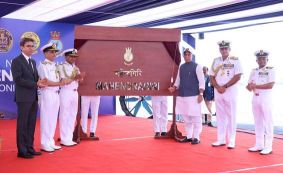
Visakhapatnam, July 11 (TNT): The Indian Navy on Saturday commissioned the indigenously-built stealth frigate INS Mahendragiri into its Eastern Fleet, with Defence Minister Rajnath Singh describing the warship as a symbol of India’s growing self-reliance in defence manufacturing and maritime capability.
Commissioned at a ceremony in Visakhapatnam, INS Mahendragiri is the sixth Project 17A stealth frigate inducted into the Navy in the last 18 months.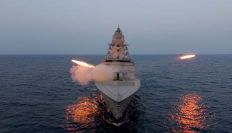
Designed by the Navy’s Warship Design Bureau and built by Mazagon Dock Shipbuilders Limited (MDL), Mumbai, the warship has over 75 per cent indigenous content.
The 6,670-tonne frigate is capable of undertaking fleet air defence, anti-surface and anti-submarine warfare, maritime interdiction, surveillance and humanitarian assistance and disaster relief (HADR) operations.
It can achieve speeds of up to 28 knots and is equipped with advanced stealth features, network-centric combat systems, modern sensors, electronic warfare systems and an embarked multi-role helicopter.
Addressing the gathering, Rajnath said the commissioning reflects India’s growing capabilities in indigenous shipbuilding, supported by strong design expertise, manufacturing excellence and an expanding naval-industrial ecosystem.
He said the warship can be armed with the BrahMos supersonic cruise missile and is equipped with advanced air defence systems, anti-submarine weapons, indigenous rocket launchers, torpedo launchers, electronic warfare suites and close-in weapon systems, making it a formidable combat platform capable of safeguarding India’s maritime interests across the Indian Ocean.
The Defence Minister said while emerging technologies such as artificial intelligence, drones, cyber warfare and hypersonic weapons are transforming modern warfare, conventional military strength remains the foundation of national security.
“Future wars may be fought with artificial intelligence, but they will still be won by national resolve, trained soldiers and credible military power,” he said, adding that Operation Sindoor demonstrated the effective integration of conventional and modern military capabilities.
Highlighting the strategic importance of maritime security, Rajnath said the Indian Navy has established itself as a “First Responder” and “Preferred Security Partner” in the Indo-Pacific through humanitarian assistance, anti-piracy missions and evacuation operations.
He noted that under Operation Urja Suraksha, the Navy safely escorted 18 merchant vessels carrying cargo worth over ₹9,000 crore during the West Asia conflict.
He said indigenous warship construction not only strengthens defence preparedness but also boosts sectors such as steel, electronics, propulsion systems, precision engineering and software, generating employment and supporting economic growth.
The Defence Minister reiterated the government’s commitment to making India a global hub for shipbuilding and maritime defence innovation through initiatives including Maritime India Vision 2030, the Maritime Development Fund, the Shipbuilding Financial Assistance Scheme and the Shipbuilding Development Scheme.
Chief of the Naval Staff Admiral Krishna Swaminathan said INS Mahendragiri marks another milestone in India’s indigenous warship construction programme and significantly enhances the Navy’s operational capability.
He said the Project 17A programme has reduced the launch-to-delivery timeline by nearly 50 per cent, from 63 months to 31 months, while the overall construction period has been brought down from 95 months to 75 months. He also noted that all technical evaluations for the vessel were completed in a single sea trial instead of the conventional five to seven trials.
The commissioning ceremony was attended by senior naval officers, representatives of the shipbuilding industry and defence veterans.
TNT KM