India to Add 11 New Flying Training Organisations Across Seven AAI Airports
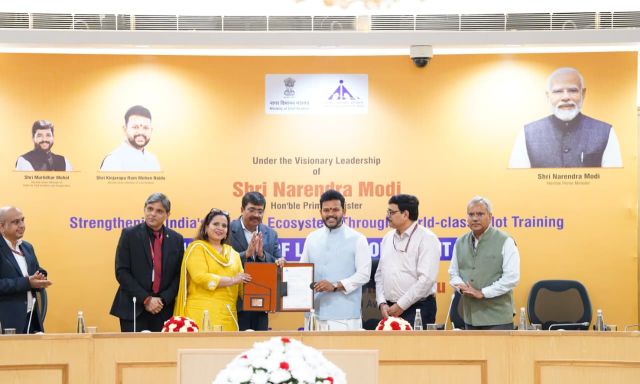
New Delhi, Aug. 5 (TNT): The government on Wednesday awarded Letters of Intent (LoIs) for setting up 11 new Flying Training Organisations (FTOs) across seven Airports Authority of India (AAI) airports as part of efforts to expand India’s pilot training capacity and strengthen the civil aviation workforce.
The LoIs were awarded by Union Civil Aviation Minister Kinjarapu Rammohan Naidu, who said the expansion would add capacity for training around 750 additional cadets annually and support the growing requirements of the aviation sector.
Currently, 41 FTOs are operating from 63 flying bases across the country, the Union Minister said the initiative would help build a stronger domestic pipeline of trained aviation professionals in line with India’s expanding aviation market.
Addressing the gathering, Rammohan Naidu said India has emerged as one of the world’s fastest-growing aviation markets and that the government is focusing on expanding infrastructure and developing a future-ready workforce under the vision of Viksit Bharat and Aatmanirbhar Bharat.
He said the FTO ecosystem has witnessed significant growth in the last two years, with six new FTOs established and the number of training aircraft increasing from 324 to 385. This has resulted in a 25 per cent increase in annual flying hours across the pilot training ecosystem.
The Union Minister said the number of Commercial Pilot Licences (CPLs) issued increased from 1,347 in 2024 to 1,652 in 2025, the highest in the last decade, with further growth expected in 2026.
Highlighting the future demand for aviation professionals, he said Indian airlines currently have 1,640 aircraft on order, with nearly 500 aircraft expected to join the fleet over the next five years.
He said the government’s vision was “Train in India, Fly in India”, supported by reforms such as liberalisation of FTO policies, abolition of airport royalties, rationalisation of land rentals and digitisation of CPL examination processes.
The Union Minister also highlighted the DGCA FTO Ranking Framework, saying it has improved transparency and encouraged better performance among training organisations. He said the framework has resulted in a reduction in Category ‘C’ FTOs and an increase in Category ‘B’ FTOs.
He noted that Indira Gandhi Rashtriya Uran Akademi (IGRUA) recorded an average of 1,765 flying hours per aircraft annually during the last six months, exceeding the global benchmark of around 1,500 hours.
Rammohan Naidu also highlighted progress in the development of indigenous trainer aircraft HANSA-3 (NG), describing it as an important step towards strengthening India’s self-reliant aviation ecosystem.
Emphasising safety as the top priority, the Minister called for stronger instructor oversight, strict adherence to standard operating procedures and development of a robust safety culture across all FTOs.
During the event, the Union Minister launched the FTO IFR Slot Booking Mobile App, which will enable flying training organisations to view available IFR training slots at AAI airports and submit slot requests digitally.
The programme was attended by Civil Aviation Secretary Samir Kumar Sinha, Additional Secretary Puneet Kansal, AAI Chairman Vipin Kumar, senior officials from the Ministry of Civil Aviation, DGCA, AAI and representatives of FTOs from across the country.
TNT TS