IIT Madras-led multi-institute study Calls for Greater Role of Women Police in Handling Gender Crimes
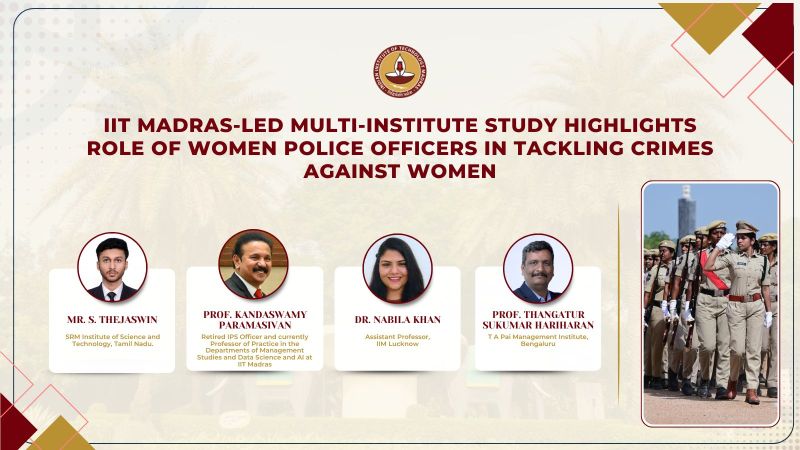
Chennai, June 29 (TNT): A multi-institutional study led by the Indian Institute of Technology Madras (IIT Madras) has found that greater participation of women in police forces improves institutional response to gender-based crimes, increases reporting by victims and strengthens public trust in the justice delivery system.
The study, conducted jointly by researchers from IIT Madras, Indian Institute of Management (IIM) Lucknow, T.A. Pai Management Institute (TAPMI), Bengaluru, and SRM Institute of Science and Technology, also cautioned against excessive reliance on informal dispute resolution mechanisms in gender crime cases, warning that it could weaken long-term legal accountability.
The findings have been published in the peer-reviewed journal Systems Research and Behavioral Science, the Institute said in a release here on Monday.
The research examined whether higher representation of women in India’s police force leads to better justice outcomes, improved institutional responsiveness and greater confidence among victims of gender-based crimes.
The researchers conducted pan-India focus group discussions involving police personnel and validated the findings with criminologists, psychologists, social workers and legal experts.
According to the study, women constituted only 11.75 per cent of India’s police force as of 2022, highlighting their continued underrepresentation despite various policy initiatives.
Professor Kandaswamy Paramasivan of IIT Madras, a retired IPS officer and one of the authors of the study, said greater participation of women police personnel encouraged victims to report crimes by fostering trust and improving institutional responsiveness.
He said women officers also positively influenced policing by bringing a more empathetic and victim-centric approach.
Dr. Nabila Khan of IIM Lucknow said increasing the number of women in policing alone would not be sufficient and stressed the need for leadership opportunities, specialised training, institutional support and accountability mechanisms to enable them to contribute effectively to justice delivery.
The study also highlighted what the researchers termed the “Alternative Dispute Resolution (ADR) Paradox”, cautioning that excessive dependence on informal mediation in cases of gender-based violence could embolden repeat offenders by weakening formal legal action.
Professor Thangatur Sukumar Hariharan of TAPMI said while mediation may help preserve family stability in certain cases, the victim’s preference must remain paramount and formal complaints should be registered whenever the victim seeks legal action.
The researchers said affirmative measures such as reservation policies, recruitment drives, maternity benefits, childcare leave and improved healthcare facilities have encouraged greater participation of women in policing.
They recommended specialised training for women police personnel handling gender crimes, regular independent reviews of crimes against women, public awareness campaigns and improved conviction rates to further strengthen public confidence in the criminal justice system.
TNT KS