
IIIT-Hyderabad marks release of book on UPI’s rise
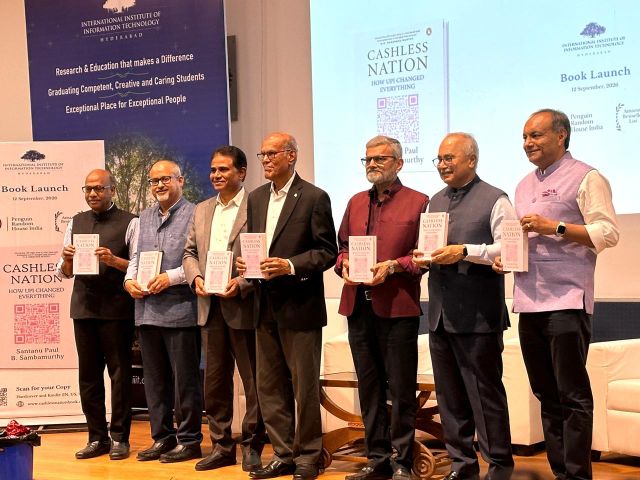
Hyderabad, Sept 12 (TNT): The International Institute of Information Technology, Hyderabad (IIIT-Hyderabad) on Saturday marked the release of “Cashless Nation: How UPI Changed Everything”, a book by Dr Santanu Paul and B. Sambamurthy that chronicles the evolution of India’s Unified Payments Interface (UPI) and the country’s emergence as a digital payments powerhouse.
The book, published by Penguin Random House, was released in the presence of former Reserve Bank of India Governor Dr D. Subbarao, G.V. Prasad, Srini Raju and U.B. Desai.
The book traces the development of UPI over several decades, covering the people, institutional decisions, technological innovations and implementation efforts behind India’s digital payments transformation.
Noting that UPI completed 10 years this year, the authors highlight its growing use across sectors, from small street-side vendors and kirana stores to doctors, restaurants and large e-commerce companies.
The book examines the evolution of UPI through the broader objective of financial inclusion and draws on interviews with several key individuals involved in its development.
Dr Subbarao said UPI had evolved beyond being a payment product into an open and interoperable public infrastructure that had transformed financial inclusion and enabled private innovation.
He said the development of UPI was the result of institutional decisions, technological innovation and sustained execution, describing the book as an account of that journey.
IIIT-Hyderabad Director Prof Sandeep Shukla congratulated the authors and said the book captured an important phase in India’s journey towards a cashless economy. He said UPI had positioned India as a global leader in payment technology.
The authors, who have been associated with NPCI and IDRBT and served on various boards and committees in India’s financial sector, bring technology and banking perspectives to the book, according to the release.
The book examines the potential of digital payments to improve efficiency, bridge economic divides and contribute to wider economic transformation, and is aimed at readers interested in technology, finance, policy, enterprises and startups.
TNT TS