
Hyd: Experts call for Technology-Driven Reforms, stronger Cyber Capabilities and Ethical AI Adoption in Policing
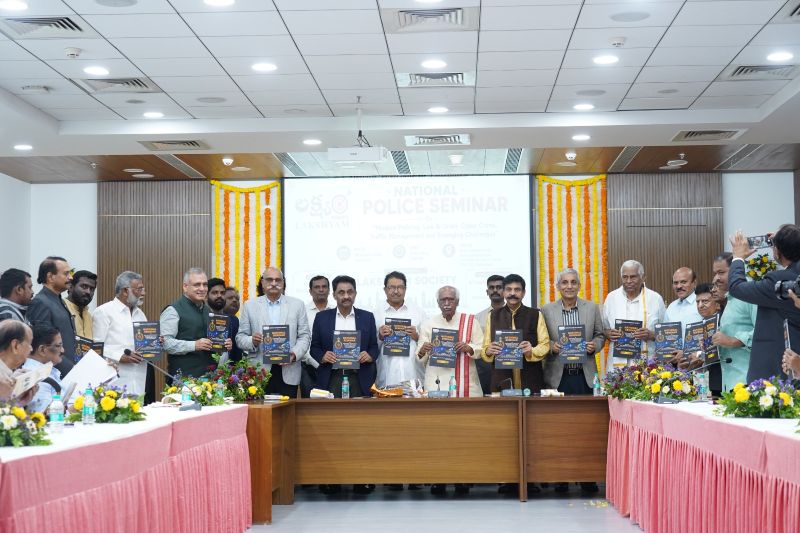
Hyderabad, Aug 8(TNT): With technology rapidly reshaping the nature of crime, experts at a national-level police seminar here on Saturday called for modernising policing systems, strengthening cyber capabilities and ensuring ethical and accountable use of Artificial Intelligence to tackle emerging security challenges.
The experts were participating in a day-long seminar on “Modernization of Police Force, Law & Order, Cyber Crime, Traffic Management, and Emerging Challenges”, organised under the aegis of Lakshyam Charitable Society at the TG Integrated Command Control Centre (TG ICCC) here.
The seminar was inaugurated and chaired by former Haryana Governor Bandaru Dattatreya.
Kapilavai Dileep Kumar, Chairman of Lakshyam Charitable Society, former MLC and former PS to the Home Minister, Andhra Pradesh, convened the event, which brought together senior serving and retired police officers, administrators, legal experts, cybersecurity professionals and policymakers from across the country.
The day-long deliberations focused on the rapidly evolving nature of crime and the need to equip law enforcement agencies with advanced technology, specialised skills and coordinated response mechanisms.
Experts said conventional policing methods alone were no longer sufficient to deal with crimes that increasingly transcend geographical boundaries.
Cybercrime, organised crime, financial fraud, AI-enabled offences, deepfakes, drone-related threats and cyberattacks targeting critical infrastructure figured prominently in the discussions.
During sessions on cybercrime and digital security, participants stressed the need for dedicated cyber investigation units, advanced digital forensic infrastructure and stronger coordination among law enforcement agencies at the national and international levels.
Rising incidents of online banking fraud, UPI scams, phishing attacks, identity theft and investment fraud were identified as major challenges requiring specialised expertise and faster investigative responses.
The seminar also examined the opportunities and risks associated with Artificial Intelligence (AI) in policing. Experts said AI-powered systems could enhance crime detection, facial recognition, predictive policing, smart traffic management and emergency response mechanisms.
At the same time, they cautioned against the misuse of AI for deepfake generation, voice cloning, automated phishing and identity fraud. They stressed that the adoption of AI by law enforcement agencies should be backed by clear ethical standards, transparency and accountability.
On drone technology, experts highlighted its growing applications in surveillance, disaster response, traffic monitoring and search-and-rescue operations.
However, they also raised concerns over the use of drones for narcotics trafficking, weapons smuggling, unauthorised surveillance and cross-border infiltration, and called for stronger anti-drone capabilities and regulatory mechanisms.
Deliberations on financial crimes and digital evidence management covered challenges arising from cryptocurrency-related offences, money laundering, shell companies and sophisticated online frauds.
Experts emphasised the need for closer coordination among cyber specialists, forensic experts, banking institutions and investigative agencies, besides scientific preservation and analysis of electronic evidence obtained from mobile devices, CCTV systems and cloud platforms.
The seminar also stressed that community policing and public trust remain central to effective law enforcement, even as police forces adopt increasingly sophisticated technologies.
Participants called for transparent policing practices, victim-centric approaches, stronger women and child safety measures and continuous capacity-building of police personnel in cyber investigation, forensic science, AI, leadership and stress management.
The seminar was attended by several distinguished personalities, including Sudhir Rajpal, Additional Chief Secretary (Home Affairs), Haryana; Rajendra Kumar, IPS (Retd.), former DGP, Jammu & Kashmir; K. Padmanabhaiah, IAS (Retd.), former Union Home Secretary, Government of India; C. Gopinath Reddy, IPS (Retd.), former DGP (Prisons), undivided Andhra Pradesh; Durga Prasad Kode, IPS (Retd.), former DGP, Andhra Pradesh and former DG, CRPF; U. Rama Mohan, former SP (Cyber Crimes) and forensic expert; Sanjay Kundu, IPS (Retd.), former DGP, Himachal Pradesh; V.C. Sajjanar, IPS, Commissioner of Police, Hyderabad; Md. Shakeel Akhter, IPS (Retd.), former DGP, Tamil Nadu; and Aruna Bahuguna, IPS (Retd.), former Director, SVP National Police Academy, besides several retired police officers and eminent personalities.
The organisers said the recommendations and key outcomes of the seminar would be submitted to the Central and State Governments for consideration in future policing strategies, reforms and modernisation initiatives.
Concluding the seminar, Dileep Kumar said the event had brought together experts and stakeholders on a common platform to evolve a roadmap for a modern, proactive and technology-enabled policing framework.
TNT TS