Industry-Academia Partnership Crucial for India’s Next Growth Phase: Jitendra Singh
Hyderabad, June 30 (TNT): Union Minister Jitendra Singh on Tuesday said stronger partnerships between agricultural research institutions and industry would drive India’s next phase of economic growth by creating greater value from scientific innovation.
Addressing scientists after inaugurating four advanced research and development facilities at the CSIR-Indian Institute of Chemical Technology (CSIR-IICT), he said scientific priorities under the leadership of Prime Minister Narendra Modi had expanded beyond crop improvement to developing technologies that convert agricultural waste and residues into value-added products.
He said scientific interventions across the agricultural value chain would create new opportunities for farmers, industry and the economy by promoting value addition, rural entrepreneurship and sustainable industrial growth.
During the programme, the Union Minister inaugurated the Advanced R&D Facility for Fluorochemicals and virtually dedicated to the nation the 500 KLD Decentralized Effluent Treatment Plant for the Siripuram Handloom Cluster, the Continuous Processing Platform for Industrial Chemicals, and the Sustainable Engineering Complex (SustEC).
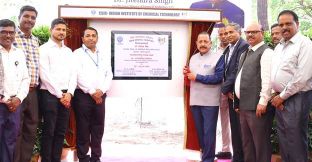
He also laid the foundation stone for a ₹44.46-crore hostel complex with accommodation for 200 students and research scholars.
Jitendra Singh said research institutions could no longer function in isolation and must work closely with industry, MSMEs, startups and technology partners to accelerate innovation and commercialisation.
He said India was steadily transforming from a technology adopter into a technology developer, with science emerging as a key driver of economic growth, strategic self-reliance and global competitiveness.
Highlighting CSIR’s recent innovations, the minister said technologies for producing compressed biogas from food and agricultural waste and converting captured carbon dioxide into dimethyl ether reflected India’s commitment to clean energy, the circular economy and sustainable industrial development.
Describing the Advanced R&D Facility for Fluorochemicals as a strategic national asset, he said it would strengthen indigenous capabilities in fluorination technologies and support the development of pharmaceuticals, agrochemicals, specialty chemicals, refrigerants, electronic chemicals and advanced materials while reducing dependence on imports.
Referring to the decentralized effluent treatment plant for the Siripuram handloom cluster, he said the project demonstrated how scientific innovation could directly benefit traditional industries by reducing pollution, protecting groundwater, enabling water reuse and promoting sustainable textile production.
The Union Minister said the Continuous Processing Platform would help the chemical and pharmaceutical industries adopt globally competitive manufacturing technologies by improving productivity, safety and product quality.
He described the Sustainable Engineering Complex as a major initiative supporting India’s transition towards a circular economy by converting waste plastics, biomass, agricultural residues and industrial by-products into fuels, hydrogen and advanced materials.
Jitendra Singh said all four facilities were designed to bridge laboratory research with industrial applications and support startups, MSMEs and established industries in commercialising indigenous technologies.
He also welcomed the recent recruitment of nearly 90 permanent personnel, including around 70 scientists and technical professionals, at CSIR-IICT and said investment in scientific talent should be matched by world-class research infrastructure.
The programme was attended by Director, CSIR-IICT, Dr. D. Srinivasa Reddy; Director, CSIR-CCMB, Dr. Vinay K. Nandicoori; Director, CSIR-NGRI, Dr. Prakash Kumar; Director, CSIR-NEERI, Dr. S. Venkata Mohan; and Director, CDFD, Prof. Ullas Kolthur-Seetharam, among other scientists, industry representatives, strartups and research scholars.
TNT TS