
Bhupender Yadav Calls for Science-Based Tiger Conservation, Community Participation at National Workshop
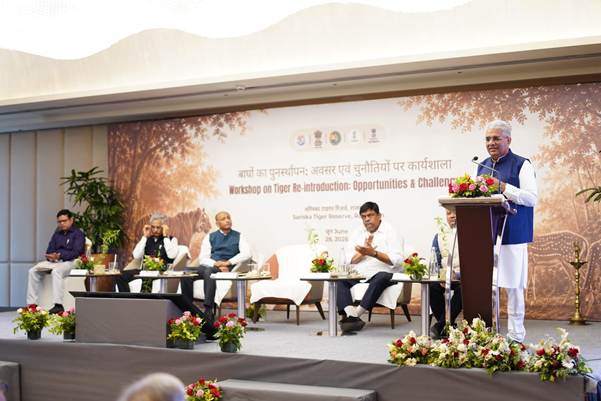
Alwar (Rajasthan), June 28 (TNT): Union Environment, Forest and Climate Change Minister Bhupender Yadav on Sunday said tiger conservation is not merely about protecting a single species but about conserving forests, watersheds and biodiversity, while stressing the need for science-based management and active community participation in wildlife conservation.
Inaugurating the National Workshop on “Tiger Re-introduction: Opportunities & Challenges” here, Yadav described the Sariska tiger reintroduction programme as a historic milestone in global wildlife conservation, saying it was the world’s first successful scientific reintroduction of tigers into a landscape where the species had become locally extinct.
The workshop, organised by the National Tiger Conservation Authority (NTCA) in collaboration with the Rajasthan government, marked 18 years of tiger reintroduction in the Sariska Tiger Reserve.
Yadav said Sariska had recovered remarkably from local extinction in 2005 to supporting 56 tigers today, making it a global model for species restoration through scientific management, sustained conservation efforts and community participation.
Highlighting India’s achievements in tiger conservation, the Union Minister said the number of tiger reserves in the country had increased from 46 to 58 over the past decade and India had successfully met the St. Petersburg Declaration target of doubling its wild tiger population by 2022.
He said the successful reintroduction of tigers in Sariska and Panna Tiger Reserves was made possible due to the active support of local communities, while noting that similar efforts in Odisha’s Satkosia Tiger Reserve could not succeed because of the lack of community participation.
Yadav also said Project Cheetah had benefited significantly from community involvement and stressed that the interests and welfare of local people must receive equal importance alongside efforts to promote wildlife tourism.
Emphasising the need for integrated landscape management, he said areas with overlapping tiger and elephant habitats should focus on maintaining ecological connectivity.
He called for identifying suitable source and sink populations and adopting scientific strategies for future tiger reintroduction programmes.
“Our priority is to ensure that our tigers are protected, our forests remain green and healthy and local communities continue to prosper,” the Union Minister said, adding that the government’s objective is to ensure no species becomes extinct and to restore threatened wildlife through scientific and humane conservation approaches.
On the occasion, Yadav released three publications—Road Map on Active Management of Tigers in India, Booklet on Reintroduction and Recovery of Tigers in India, and the Annual Report of Project Cheetah (September 2024–December 2025).
The workshop featured technical sessions on habitat restoration, prey augmentation, wildlife translocation, landscape connectivity, monitoring protocols and active management strategies.
Participants shared experiences from tiger reintroduction programmes in Sariska, Panna and other reserves, while deliberating on future strategies for restoring tiger populations in tiger-deficient landscapes through science-based conservation planning.
Rajasthan Forest Minister Sanjay Sharma, Director General of the International Big Cat Alliance S.P. Yadav, Director General of Forests and Special Secretary, Ministry of Environment, Forest and Climate Change, Sushil Kumar Awasthi, NTCA Member Secretary Sanjay Kumar and senior wildlife experts attended the workshop.
TNT TS