India targets debris-free space by 2030: Jitendra Singh
Hyderabad, Nov 5 (TNT) : Union Minister of State for Science and Technology Jitendra Singh on Thursday said India was emerging as one of the early global pioneers in space debris removal, with domestic startups developing advanced technologies to make outer space safer and more sustainable.
Announcing India’s vision of achieving debris-free space by 2030, he said the country’s growing capabilities in active space debris removal reflected its expanding global leadership in space technology and commitment to ensuring a safe space environment for humanity.
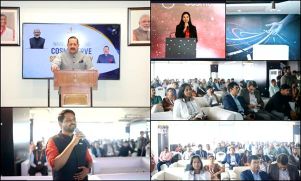
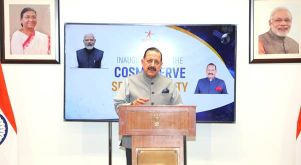
Speaking virtually from New Delhi at the inauguration of Cosmoserve Space’s Base 1 facility at VSD Tech Park, Gachibowli, here, the Union Minister said the 14,800 sq ft facility marked a significant advancement in India’s private space capabilities.
The facility houses specialised laboratories for orbital rendezvous and capture, space robotics innovation, microgravity simulation and satellite integration, besides infrastructure for designing, building, testing and operating space robots.
Congratulating Cosmoserve Space Founder and CEO Dr Chiranjeevi Phanindra and his team, Singh highlighted the company’s work in active debris removal and in-orbit servicing.
He cited Mission EMBRACE, which conducted an in-space test of soft robotic petals in July 2026, within a year of the company’s formation, as an example of the rapid progress of India’s private space startups.
He said the team’s experience in ISRO and the Gaganyaan programme was being translated into a collaborative private-sector model.
Partnerships with Pixxel, Dhruv Aerospace Netherlands and Skyroot Aerospace for satellite systems, propulsion systems and launch services respectively demonstrated the emergence of an integrated space technology ecosystem in the country, he said.
Crediting Prime Minister Narendra Modi’s space sector reforms for transforming India’s space ecosystem, Singh said the establishment of NewSpace India Limited and IN-SPACe had opened up new opportunities for private enterprises.
India’s space economy had grown to nearly USD 9 billion and was projected to reach USD 40-45 billion over the next decade, while the country’s space startup ecosystem had expanded from single-digit numbers to nearly 450 enterprises, he said.
Observing that India had never lacked scientific talent or technological capabilities, the Minister said an enabling ecosystem was necessary to harness the potential of its youth.
He called upon domestic and international investors to increase investments in the space sector and urged greater philanthropic support for science and research.
Stressing the importance of technological self-reliance and sovereign capabilities alongside international partnerships, he said India’s achievements in Chandrayaan and Gaganyaan demonstrated its ability to undertake sophisticated space missions at significantly lower costs.
Space technology was also transforming life on Earth through applications in Gati Shakti, smart cities and disaster preparedness, among other areas, he added.
Telangana IT and Industries Minister D Sridhar Babu attended the inauguration as Guest of Honour, while Cosmoserve Space Founder and CEO Dr Chiranjeevi Phanindra was present.
Describing the initiative as an expression of the spirit of Vishwa Bandhu Bharat, Singh said India’s commitment to space sustainability extended beyond national boundaries for the benefit of humanity.
He congratulated the company for contributing to a cleaner and safer space environment and expressed his desire to visit the facility in person.
TNT TS