Telangana govt highlights 1,000 days of governance, outlines $3 trillion vision
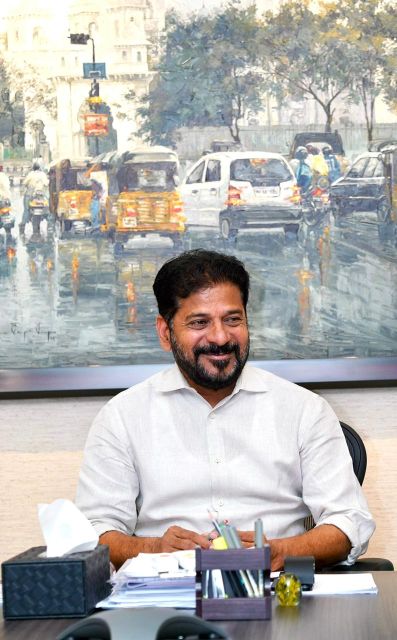
Hyderabad, Aug 30 (TNT): The Telangana government on Sunday highlighted its achievements in the first 1,000 days of the People’s Government under Chief Minister A Revanth Reddy, focusing on welfare, agriculture, social justice, employment, infrastructure and economic growth.
The government said Telangana’s per capita income rose to Rs 4,18,931 in 2025-26, around 91 per cent higher than the national per capita income.
It also highlighted investments attracted to the state and measures aimed at strengthening its financial position while continuing welfare programmes.
In agriculture, the government said it waived farm loans of up to Rs 2 lakh, benefiting more than 25 lakh farming families.
Over Rs 36,000 crore was provided under the Rythu Bharosa scheme, while the government spent around Rs 1.68 lakh crore on agriculture and farmer welfare over the past 32 months.
The state also claimed that Telangana surpassed Punjab to become the country’s leading state in paddy cultivation and production, procuring 81.12 lakh metric tonnes during the last Yasangi season.
Under women’s welfare schemes, the government said more than 335 crore free journeys had been made by women under the Mahalakshmi scheme, resulting in savings of nearly Rs 11,000 crore in travel costs.
Free electricity of up to 200 units was being provided to over 53 lakh families under Gruha Jyothi, while 43 lakh families were receiving LPG cylinders at Rs 500.
Bank-linked loans of Rs 60,487 crore were extended to 4.54 lakh women’s groups, along with an interest subsidy of Rs 1,900 crore.
The government said more than 15 lakh new ration cards had been issued, providing food security to around 3.38 crore people through the Public Distribution System.
It also said new social security pensions had been sanctioned for 2.25 lakh people, taking the total number of beneficiaries to more than 43 lakh.
On housing, the government said 4.5 lakh Indiramma houses had been constructed in the first phase, with financial assistance of Rs 5 lakh being provided to eligible families.
A plan was also envisaged to construct one lakh multi-storey Indiramma housing units within Hyderabad’s urban limits.
The government highlighted its social justice measures, including a state-wide socio-economic survey and implementation of SC sub-categorisation, under which 59 SC sub-castes were classified into three groups.
It also said the Assembly had approved bills providing 42 per cent reservation for BCs in education, employment and politics.
In education, Telangana improved its position in the Performance Grading Index from 28th to 18th, while 105 Young India Integrated Residential Schools had been sanctioned.
The government also said 10,006 teachers were recruited through the Mega DSC and scholarships and fee reimbursements were being provided to around 11 lakh students.
The government said more than 72,000 government job appointments had been made during the first 1,000 days.
It also highlighted skill-development initiatives, including the Young India Skills University, and said 1,190 people had completed training there, with 838 securing jobs.
In healthcare, the Rajiv Aarogyasri coverage limit was increased from Rs 5 lakh to Rs 10 lakh.
The government said a new 2,000-bed Osmania Hospital was being constructed at Goshamahal at a cost of Rs 2,700 crore and three TIMS super-speciality hospitals were being developed at Sanathnagar, Alwal and LB Nagar.
It also said nine new government medical colleges had been established and another 17 were under construction. Between December 7, 2023 and August 12, 2026, Rs 2,526.12 crore was provided to 5,18,186 people through the Chief Minister’s Relief Fund.
The government said it had intensified action against food adulteration and established the TG Safe agency to tackle food adulteration and drugs.
It also highlighted the Eagle system for combating drugs and measures making anti-drug and safety committees mandatory in educational institutions.
On infrastructure, the government said work was progressing on the 360-km Regional Ring Road, while plans had been finalised for 6,092 km of HAM roads across the state.
The Hyderabad Metro’s Phase-II expansion would cover 122.9 km across seven corridors. The government also highlighted the development of Mamnoor Airport, Adilabad airstrip and the Musi rejuvenation project.
The government said Telangana had secured investments worth Rs 1.29 lakh crore through TG-iPASS and investment agreements worth Rs 5.75 lakh crore were signed at the Telangana Rising Global Summit-2025. Investments worth Rs 92,281 crore were also made in TSIIC lands, potentially creating more than 78,000 jobs.
In the IT sector, Telangana’s IT exports were projected at Rs 3.97 lakh crore for 2025-26, with 12.14 lakh direct IT jobs. Hyderabad had more than 355 Global Capability Centres, with 40 new centres selected for the city in 2026, the government said.
It also highlighted an additional $7 billion investment by Amazon and the establishment of the TG-DEX, described as the country’s first state-level AI data exchange.
Looking ahead, the government said it had set a target of transforming Telangana into a $1 trillion economy by 2034 and a $3 trillion economy by 2047.
It outlined plans for balanced development through CURE, PURE and RARE corridors and proposed developing Bharat Future City as the country’s first net-zero smart city.
The government said initiatives including AI infrastructure, data centres, the Regional Ring Road, Hyderabad Metro Phase-II, Musi rejuvenation, Young India Skills University and a Sports University would form part of its long-term development strategy.
TNT TS