Women’s Representation in IAS Reaches Record 41%, Says Jitendra Singh
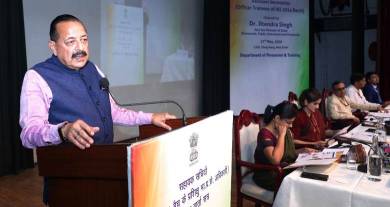
New Delhi, May 27 (TNT): Women’s representation in the 2024 batch of the Indian Administrative Service (IAS) has reached nearly 41 per cent, marking one of the highest levels of gender participation in the history of the civil services, according to Union Minister of State (Independent Charge) for Science & Technology, Earth Sciences, PMO, Personnel, Public Grievances, Pensions, Atomic Energy and Space, Jitendra Singh.
Interacting with IAS officer trainees of the 2024 batch at the Civil Services Officers’ Institute (CSOI) in New Delhi on Wednesday, Jitendra Singh said the changing profile of India’s civil services reflected the broader transformation taking place across the country, where access to opportunities was expanding beyond traditional social and regional boundaries.
He said the officers entering service today would occupy leadership positions when India completes 100 years of Independence in 2047 and described the moment as both a privilege and a responsibility.
The interaction was held as part of the Assistant Secretary Programme under which 184 IAS officers of the 2024 batch have been attached to 49 Ministries and Departments of the Government of India for an eight-week period from May 4 to June 25, 2026.
Senior officials present at the programme included Additional Secretary, Department of Personnel and Training (DoPT), Faiz Ahmed Kidwai, Joint Secretaries P. Bala Kiran and Chhavi Bhardwaj, and officials from the Lal Bahadur Shastri National Academy of Administration (LBSNAA).
Jitendra Singh said the Assistant Secretary Programme, introduced under the leadership of Prime Minister Narendra Modi, had significantly changed the early administrative exposure available to young IAS officers by making them more policy-oriented and institutionally connected from the beginning of their careers.
Highlighting the educational diversity of the batch, he said 78 officers came from engineering backgrounds, while others represented medicine, law, management and humanities disciplines.
He noted that governance today increasingly requires technological understanding and interdisciplinary thinking as government programmes become more data-driven, digital and innovation-oriented.
Jintendra Singh also referred to changing regional trends in civil services selections, stating that several states which earlier had limited representation were now producing large numbers of successful candidates, reflecting the rise of a more aspirational India.
Encouraging officers to continuously upgrade their skills, he urged them to make use of platforms such as Mission Karmayogi and develop expertise in areas including artificial intelligence, digital governance, data analytics and public communication.
He said future administrators would need to combine technological competence with empathy, ethical conduct and sensitivity towards citizens.
Describing India@2047 as a national mission, he urged the young officers to approach public service with humility, discipline and a strong sense of national purpose.
TNT KS