India developing standard template for future bullet train corridors
New Delhi, July 3 (TNT): With the Mumbai-Ahmedabad High Speed Rail (MAHSR) project nearing completion, India is developing a standardised template for future bullet train corridors to accelerate the expansion of high-speed rail across the country.
The Ministry of Railways said the country’s first bullet train corridor is laying the foundation for future high-speed rail projects by standardising engineering designs, construction methods and operational practices to improve efficiency, reduce costs and speed up execution.
The MAHSR project, being built using Japanese Shinkansen technology, will feature trains with a design speed of 350 kmph and an operational speed of 320 kmph, significantly faster than the Vande Bharat trains, which have a design speed of 180 kmph.
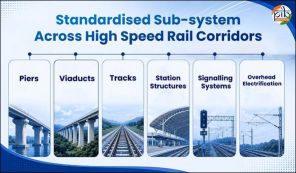
Under the proposed standardised model, future corridors will adopt common engineering standards for piers, viaducts, tracks, stations, overhead electrification and signalling systems, while foundations will be customised according to local soil conditions.
The Centre said indigenous manufacturing under the Make in India and Aatmanirbhar Bharat initiatives is also being strengthened.
The Integral Coach Factory (ICF), in collaboration with Bharat Earth Movers Limited (BEML), is developing indigenous 280 kmph high-speed train sets, while Indian companies are increasingly manufacturing specialised components, construction equipment and slab-track systems for future projects.
The 508-km Mumbai-Ahmedabad High-Speed Rail corridor will connect the two cities in about one hour and 58 minutes through 12 stations.
The first section, between Surat and Vapi, is expected to become operational in August 2027.
The project includes over 20,000 overhead electrification masts, 12 traction substations, two depot traction substations, 16 distribution substations, ballastless J-Slab track technology, dedicated track construction bases and three rolling stock depots at Sabarmati, Surat and Thane.
The government said seven additional high-speed rail corridors, covering nearly 4,000 km, have been identified for future development with an estimated investment of around Rs 16 lakh crore.
According to the Ministry, the experience gained from the Mumbai-Ahmedabad project will help establish a scalable and standardised framework for future bullet train corridors, strengthening connectivity, reducing travel time and supporting long-term economic growth.
TNT TS