IIT Guwahati Develops Energy-Efficient Artificial Synapse for Image Processing
The technology could find applications in facial recognition, robotic vision, intelligent surveillance and other smart computing systems, the Institute said in a release on Monday.
The device mimics the functioning of biological synapses in the human brain by integrating sensing, memory and information processing into a single platform, reducing the need for separate components and extensive data transfer.
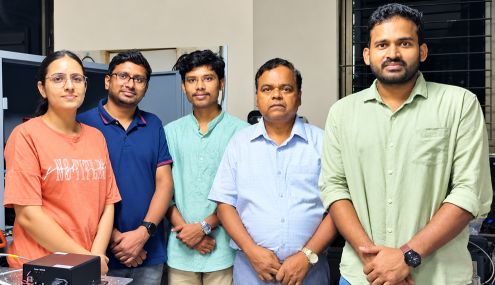
The research team, led by Prof. P.K. Giri of the Department of Physics at IIT Guwahati, used MXene nanosheets, an electrically conductive two-dimensional material, and P3HT, a light-sensitive organic semiconductor, to develop the device.
When exposed to light, electrical charges separate at the interface between the two materials and remain separated for an extended period, enabling the device to retain information even after the light source is switched off.
Prof. Giri said the device produced a persistent electrical response following a brief light signal, with repeated stimulation strengthening the response.
A second light signal generated a response 180 per cent stronger than the first, demonstrating a learning-like behaviour similar to that of biological neurons.
Laboratory tests showed that the device achieved 90 per cent accuracy in facial recognition and 85 per cent accuracy in traffic-scene segmentation.
It was developed using a low-cost solution-processing technique.
The findings have been published in the journal Carbon.
The paper was co-authored by Prof. Giri, Sanjoy Sur Roy, Dr. Sanju Nandi, Debabrata Sahu, Garima Choudhary and Prof. M. Meyyappan of IIT Guwahati, along with Saswata Goswami and Prof. Chandra Sekhar Tiwary of IIT Kharagpur.