Amit Shah calls for coordinated national strategy to eliminate terrorism
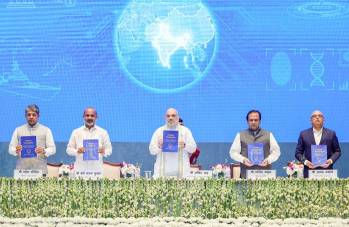
Addressing the inaugural session of the two-day national counter-terrorism conference here, he said India had been confronting terrorism for a long time, but the lack of coordinated action among police forces of different states had posed challenges in the past.
Over the years, efforts had been made to overcome these shortcomings, and a uniform strategy to combat terrorism was now being put in place across the country, from Kashmir to Kanyakumari and Dwarka to Kamakhya, extending up to every police station, he said.
Shah said recent successful operations had strengthened the country’s confidence in the fight against terrorism.
The elimination of Lashkar terrorist Latif Bhat marked a significant milestone, with Kashmir becoming free of India-born terrorists after 35 years, he claimed.
Referring to action against the Shahzad Bhatti network, he said it had been declared a terrorist organisation under the Unlawful Activities (Prevention) Act (UAPA). More than 40 modules had been neutralised across the country, over 100 cases registered and more than 271 arrests made in connection with the network.
He urged state police forces to study and adopt the model of apprehending terrorists before they could execute attacks.
The Home Minister said that since 2019, a special drive had been launched to bring fugitives back to India, and 303 fugitives had so far been brought back from 36 countries.
The CBI, Ministry of Home Affairs and intelligence agencies had made special efforts in this regard, he said.
To eliminate terrorism, organised crime and drug trafficking, it was essential to bring perpetrators and masterminds operating from abroad before Indian courts, he added.
Shah said the Narendra Modi government had adopted a zero-tolerance policy towards terrorism and taken several legislative and institutional measures to strengthen the country’s counter-terrorism framework.
The NIA Act was amended in August 2019, expanding the agency’s jurisdiction and powers, while amendments to the UAPA empowered the NIA to seize properties of terrorists and enabled individuals to be designated as terrorists.
A unified action plan to counter radicalisation was prepared in September 2019 and finalised in December that year after consultations with various ministries, he said.
He cited the dismantling of the Popular Front of India (PFI) network in September 2022 as an example of coordinated police action, noting that simultaneous operations were conducted in 11 states.
The functioning of the Multi-Agency Centre (MAC) was reorganised to cover cyber security, narcotics, organised crime networks and emerging radicalisation hotspots. Its operational methodology was restructured in 2023 using advanced technology, while a National Memory Bank and a centralised database were established, he said.
Shah said 16 new NIA branch offices and two zonal offices had been approved. The agency was also empowered to investigate cases involving the protection of the interests of Indians residing abroad. A 25-point integrated action plan to curb terrorist financing was being effectively monitored, he added.
He said 70 NIA Special Courts had been established across the country and agency personnel were being provided international exposure and training.
Stressing the need for an ecosystem-based approach to counter terrorism, Shah called for stronger coordination between the Centre and states, smoother intelligence sharing and modernisation of security agencies.
He said agencies should target the entire chain of terror financing in coordination with financial investigation agencies and investigate the complete terrorist network to prevent attacks before they occurred.
Intelligence gathered at police station level should be transmitted through multiple levels to Directors General of Police (DGPs) to generate actionable intelligence, he said.
He also called for strengthening cyber expert units in the Anti-Terrorism Squads (ATS) of all states, considering the increasing use of technology in terrorist activities.
Establishing a Quadrangular Regional Security Grid in border states should also be a priority, he added.
Shah stressed that the conference should be outcome-oriented, with shared objectives, clearly defined accountability and concerted efforts by all participating agencies.
Union Minister of State for Home Affairs Bandi Sanjay Kumar, Union Home Secretary Govind Mohan, Intelligence Bureau Director Dr Mahesh Dikshit, Special Secretary (Internal Security) Anand Swarup and NIA Director General Rakesh Aggarwal were among those present.
Senior police officers from states and Union Territories, counter-terrorism agency personnel and experts in law, forensics and technology are participating in the two-day conference.
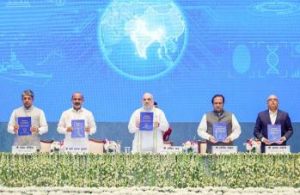
Earlier, Shah released the NIA publication ‘Fail-Safe Investigation’, laid the foundation stone for the agency’s office complex in Chandigarh and inaugurated its residential complex at Maidangarhi in Delhi. He also e-launched the NIA’s ‘Pushti’ portal and presented decorations to seven officers and personnel of the agency.