HMWSSB reviews Japanese Bio-Lace pilot project for nala treatment
Hyderabad, July 3 (TNT): The Hyderabad Metropolitan Water Supply and Sewerage Board (HMWSSB) on Friday reviewed the performance of a 1 MLD pilot sewage treatment project using Japan’s Bio-Lace technology, with officials describing it as a sustainable solution for treating polluted nalas, lakes and urban drains in the city.
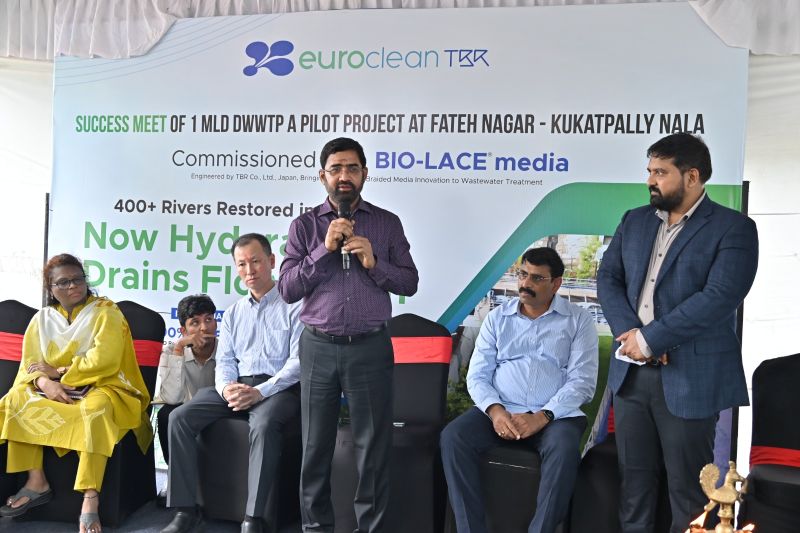
HMWSSB Managing Director K. Ashok Reddy reviewed the project at the Sewage Treatment Plant (STP) premises in Fatehnagar in the presence of representatives from the Japan International Cooperation Agency (JICA), technical experts from TBR Co. Ltd., Japan, and senior HMWSSB officials.
The pilot project, implemented with the support of JICA and TBR under a Memorandum of Understanding with HMWSSB, is the first demonstration of the Bio-Lace technology in India for the treatment of flowing polluted nala water.
Ashok Reddy said the technology, which has been used to restore more than 400 rivers and waterways in Japan, has yielded encouraging results in Hyderabad by significantly improving water quality.
He said the technology could emerge as an efficient and environmentally sustainable solution for controlling pollution in urban drains.
He said HMWSSB was implementing a comprehensive action plan in line with the directions of Chief Minister A. Revanth Reddy to ensure that untreated sewage does not enter the Musi River and that all sewage generated within Hyderabad is treated before discharge.
The Managing Director said the Board was examining the feasibility of deploying the technology directly in flowing nalas after a comprehensive evaluation of the pilot project.
According to officials, the Bio-Lace system requires 70-85 per cent less land than conventional sewage treatment plants, reduces power consumption by over 50 per cent, functions without chemicals by using naturally occurring microorganisms, generates less sludge and has lower operation and maintenance costs.
Representatives of TBR said the Hyderabad pilot project achieved a 90 per cent reduction in Biological Oxygen Demand (BOD) and an 85 per cent reduction in Total Suspended Solids (TSS), besides reducing foul odour and improving dissolved oxygen levels in treated water.
They said the feasibility of adopting the technology in future sewage treatment plants across Hyderabad would be examined after evaluation by the Pollution Control Board.
Speaking on the occasion, Vijay Kumar, Group Chief Financial Officer of Euroclean TBR Group, said India’s rapid urbanisation calls for innovative, sustainable and scalable wastewater treatment technologies.
He said the successful Hyderabad pilot had demonstrated the potential of Bio-Lace technology to help Indian cities address wastewater management challenges with lower land and energy requirements and minimal environmental impact.
TNT TS