Modi urges industry to boost domestic manufacturing, reduce import dependence

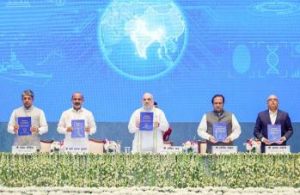
Addressing the centenary celebrations of the Federation of Indian Chambers of Commerce and Industry (FICCI) at Bharat Mandapam here, he said Indian industry should prepare a roadmap for the next 20 years by identifying new opportunities and addressing gaps in domestic manufacturing.
Congratulating FICCI on completing 100 years, Modi said the organisation had adapted to changing times and contributed to India’s economic journey.
Referring to the country’s economic progress over the past 12 years, he said around 50 crore people had come out of poverty in 12 to 13 years, citing a recent World Bank report.
India was currently the world’s fastest-growing major economy, with growth projected at around seven per cent, while merchandise exports touched a record monthly level of nearly USD 50 billion in October, he said.
The Prime Minister urged industry to identify products and sectors where India continued to depend on imports and develop domestic manufacturing capabilities.
Pointing to India’s strength in finished medicines, he said the country continued to import substantial quantities of active pharmaceutical ingredients (APIs), bulk drugs and drug intermediates.
He called upon pharmaceutical companies to invest in advanced technologies and large-scale domestic production facilities to strengthen India’s global competitiveness.
Similarly, he highlighted the need to reduce dependence on imported specialised steel and aluminium products despite the country’s substantial iron ore and bauxite resources.
Industry should identify imported grades and develop manufacturing technologies to strengthen capabilities across the mineral value chain, he said.
On agriculture, Modi said India’s share in global agricultural exports remained around two to two-and-a-half per cent despite its large production base. However, the share of processed food in agri-food exports had increased from 13 per cent to over 20 per cent during the past 12 years.
He called for a joint strategy to increase investment in agriculture, promote value addition and develop food processing capabilities to meet international demand.
The Prime Minister also highlighted opportunities in engineering products, including hand tools, power tools, packaging equipment, irrigation systems and industrial machinery.
Large companies should support smaller enterprises in improving manufacturing quality and expanding production, he said.
Stressing the government’s efforts to improve the business environment, Modi referred to the reduction in the basic corporate tax rate from 30 per cent in 2014 to 22 per cent, income tax exemption for earnings up to Rs 12 lakh, simplification of tax returns and refunds, and GST rate reductions on several goods.
These measures were aimed at increasing purchasing power and benefiting industry and businesses, he said.
Urging companies to leverage India’s recent trade agreements and reform initiatives, Modi said businesses should look beyond the domestic market and explore opportunities in international markets by understanding consumer requirements, meeting global standards and building distribution networks.
The domestic market should provide confidence to Indian businesses to compete globally rather than become their comfort zone, he said, assuring industry that the government was open to suggestions for further reforms.