Hylenr completes Phase 1 validation study of lattice-based energy technology
Hyderabad, Sept 22 (TNTI): Hyderabad-based deeptech company Hylenr on Tuesday announced the completion of Phase 1 of an independent validation study of its Lattice Confinement Fusion (LCF) technology conducted at Texas A&M University.
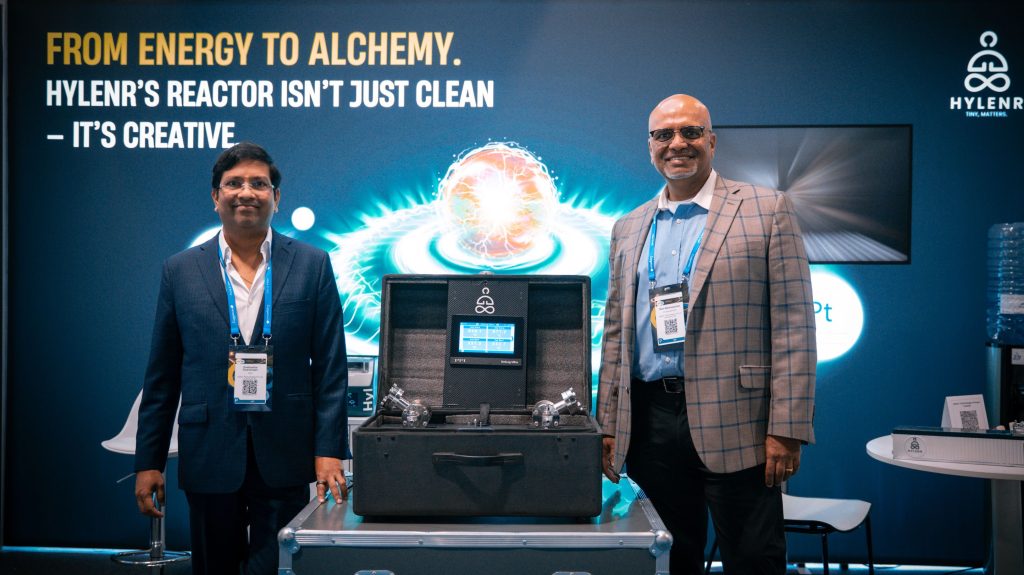
The study focused on Hylenr’s BRT-NiUCS-2 reactor, a small modular system using hydrogen-loaded nickel-palladium catalyst materials.
Multiple devices and catalyst samples were prepared and tested under controlled laboratory conditions in the Nuclear Engineering Department at Texas A&M University, the company said.
Titled “Validation of Anomalous Heat and Nuclear Signatures in the BRT-NiUCS-2 Reactor: Phase 1 LCF Investigation”, the study examined thermal performance, radiation emissions, residual gas composition and post-reaction material characteristics.
The Phase 1 research paper, co-authored by Hylenr and Texas A&M University, was presented at the 27th International Conference on Condensed Matter Nuclear Science (ICCF-27), held in Niagara Falls, Canada, from August 31 to September 4.
Hylenr Co-founder and Board Member Ram Ramaseshan said the study was aimed at subjecting the company’s technology to independent testing and generating external data through thermal measurements, gas analysis and material characterisation.
Prof Lin Shao, Professor of Nuclear Engineering at Texas A&M University, said the study used complementary analytical techniques, including thermal measurements, residual gas analysis, nuclear diagnostics and post-reaction materials characterisation.
The company said residual gas analysis using an SRS RGA 100 system under high-vacuum conditions recorded elevated helium, argon and neon signals in the active reactor compared with background measurements.
Helium and argon signals were reported at levels approximately two to three orders of magnitude above background, while no corresponding increase in nitrogen was observed.
Thermal measurements using thermocouples and calibrated infrared imaging also showed the active reactor operating at higher temperatures than the calibration device under comparable input-power conditions, according to the company.
SEM/EDX analysis further indicated morphological and compositional changes in catalyst samples following the tests.
Radiation monitoring using Geiger-Müller and neutron detectors recorded no detectable gamma or X-ray emissions, while neutron counts remained statistically indistinguishable from background during the approximately five-day monitoring period, the company said.
Hylenr said it would now proceed to Phase 2, focusing on tests involving multiple independent reactors, quantitative calorimetry and improved characterisation of loading parameters, along with isotopic-ratio measurements and advanced analytical techniques including SIMS and ICP-MS.
The company said the staged validation programme was intended to establish repeatability, quantify energy output and determine engineering requirements for potential scalable systems.
TNT TS