
India’s data centre capacity rises to 1.57 GW, projected to touch 8 GW by 2030
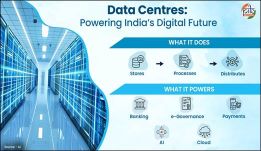
New Delhi, Sept 14 (TNT): India’s data centre sector is witnessing rapid expansion amid growing demand for computing capacity, data storage and high-speed connectivity driven by the country’s digital economy.
Installed data centre power capacity, which stood at around 375 MW in 2020, has increased to 1.57 GW as of August 2026 and is projected to reach nearly 8 GW by 2030, according to the document.
Investments of nearly USD 70 billion are already underway in the sector, with another USD 90 billion worth of projects announced.
Data centres provide the infrastructure required to support digital services, including online banking, e-governance, digital payments, cloud computing and emerging technologies.
They integrate computing, networking, power, cooling, security and management systems to ensure continuous operations and data security.
The National Informatics Centre (NIC) has established National Data Centres at Delhi, Pune, Hyderabad and Bhubaneswar, besides 37 smaller data centres at various State capitals to support government digital services.
The government has taken several policy measures to strengthen the sector. Data centres were included in the Harmonized List of Infrastructure under the Union Budget 2022-23, giving them infrastructure status and facilitating greater access to credit.
The Union Budget 2026-27 also introduced a tax holiday for eligible foreign cloud service providers until 2047 for global operations using India-based data centre infrastructure.
The second phase of the Semicon India Programme, Semicon 2.0, was approved by the Union Cabinet with an outlay of Rs 1,27,500 crore to build a trusted and resilient semiconductor ecosystem.
The IndiaAI Mission, with a budget outlay of Rs 10,371.92 crore, is also expected to drive demand for data centre infrastructure.
The allocation under the Electronics Components Manufacturing Scheme (ECMS) has been increased from Rs 22,000 crore to Rs 40,000 crore, while PLI Scheme 2.0 for IT Hardware seeks to promote domestic manufacturing of products such as servers and reduce import dependence.
With data centres requiring continuous electricity and efficient cooling, the sector’s energy requirements are also rising. According to the Central Electricity Authority, demand could reach 17 GW by 2031-32.
The government is promoting renewable energy and cleaner power through initiatives including the Green Energy Open Access Rules, Green Energy Corridor Scheme and National Green Hydrogen Mission.
The Sustainable Harnessing and Advancement of Nuclear Energy for Transforming India (SHANTI) Act is also expected to support the clean-power ecosystem for emerging sectors such as artificial intelligence and data centres, including through future deployment of small and micro nuclear reactors.
The Bureau of Indian Standards has developed standards covering data centre efficiency, including Power Usage Effectiveness, Carbon Usage Effectiveness, Cooling Efficiency Ratio and Water Usage Effectiveness.
Advanced cooling technologies such as direct-to-chip liquid cooling, adiabatic cooling and immersion cooling are also gaining importance as AI infrastructure expands.
The expansion of data centre infrastructure is expected to play an important role in India’s digital sovereignty, economic competitiveness and technological self-reliance.
The document emphasises the need for robust cybersecurity, responsible data practices, strong standards and efficient management of energy and other resources as India progresses towards its Viksit Bharat 2047 objective.
TNT KM