BITS Hyderabad Researchers Patent Low-Cost Technology for Large-Scale Microalgae Cultivation
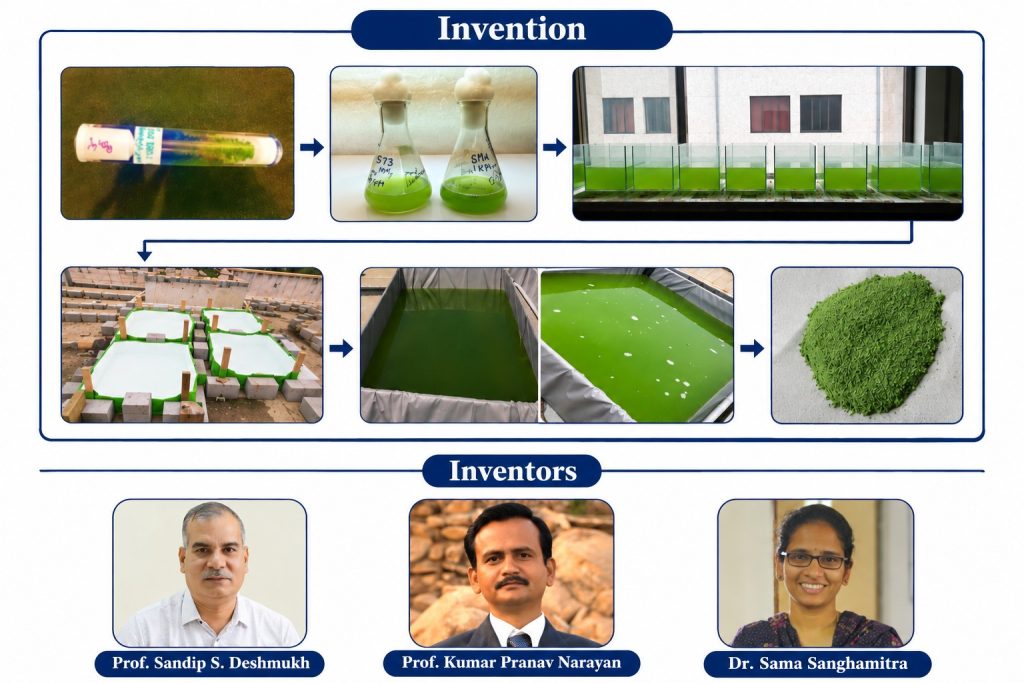
The patented technology, titled ‘Nutrient Medium Composition for Mass Cultivation of Microalgae’ (Patent No. 603126), uses locally available agricultural-grade fertilisers instead of expensive laboratory-grade chemicals to provide essential nutrients for microalgal growth, the Institute said in a release on Thursday.
The research was undertaken by Prof Sandip S Deshmukh of the Department of Mechanical Engineering, Prof K Pranav Narayan of the Department of Biological Sciences and research scholar Dr Sama Sanghamitra.
According to the research team, the cost of macronutrients required to prepare 100 litres of the newly developed medium is approximately Rs 2.40, compared with Rs 43 for conventional Bold’s Basal Medium.
The cost could increase to around Rs 4.50 when non-subsidised fertilisers are used.
The formulation has been tested under laboratory conditions, non-sterile cultivation and outdoor open-pond systems.
The researchers successfully cultivated microalgae in a 10,000-litre open pond using natural sunlight and atmospheric carbon dioxide.
Microalgae are microscopic organisms that use sunlight and carbon dioxide to produce biomass.
They have potential applications in wastewater treatment, carbon capture, biofertilisers, food products, nutraceuticals and biodiesel production.
The formulation uses agricultural-grade fertilisers to supply nutrients such as nitrogen, phosphorus, potassium and sulphur.
It can be prepared in dry powder form and dissolved in water before use, simplifying the cultivation process.
The researchers clarified that the cost comparison relates only to nutrient inputs and that the overall economics of biomass and fuel production remain to be established.
The team is in discussions with a potential industry partner for a two-month evaluation of the formulation for carbon capture, biomass production and other applications.
The proposed assessment involves supplying approximately five kg of the formulation for testing.
The researchers are also seeking industry partnerships to undertake larger-scale trials and assess the technical, environmental and commercial feasibility of the patented technology.
TNT Km