ISB hosts fourth edition of Insights Forum, honours Ashish Dhawan with Research Catalyst Award
Held during the institution’s 25th anniversary year, the forum focused on connecting academic research with real-world decision-making in business, markets and public policy, with discussions highlighting the need for research addressing local challenges while responding to global developments.
As part of the event, ISB conferred the ISB Research Catalyst Award on Ashish Dhawan, Founder-Chairperson of The Convergence Foundation, in recognition of his contributions to strengthening the research and knowledge ecosystem.
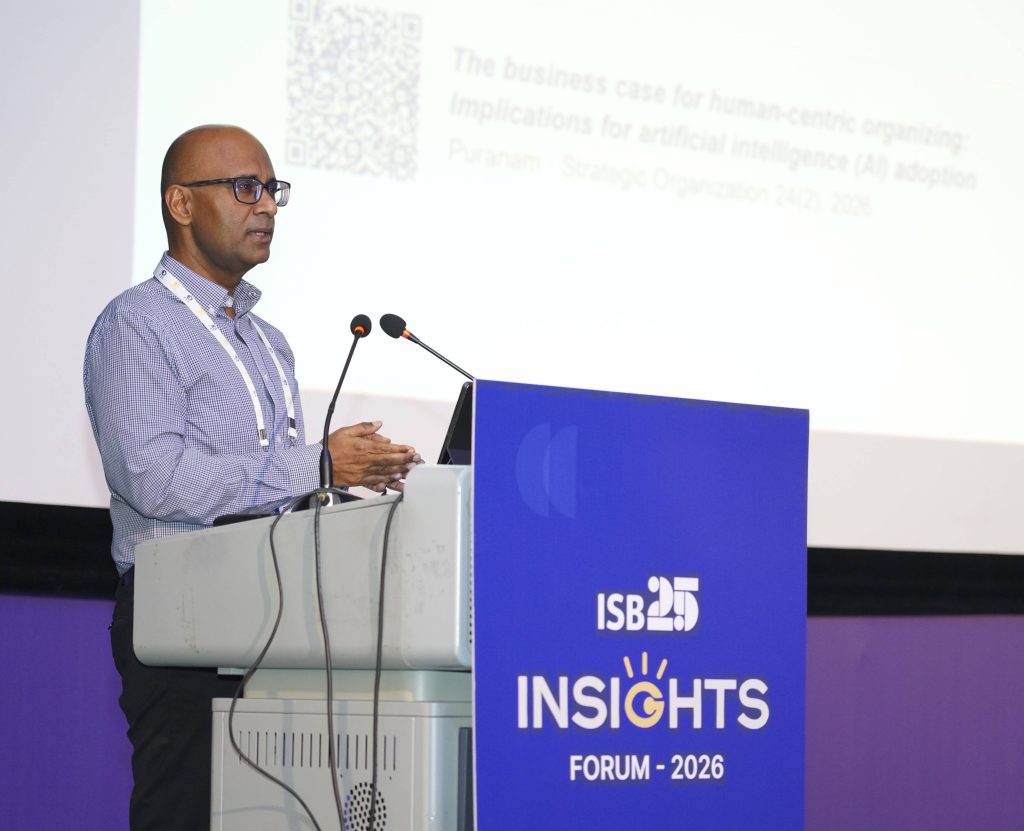
Prof. Phanish Puranam, Roland Berger Chaired Professor of Strategy and Organisation Design at INSEAD, delivered the keynote address on human-centric organisation in the age of algorithms.
Drawing on research from INSEAD’s Organizations and Algorithms Programme, he said the impact of Artificial Intelligence (AI) on organisations should be viewed as a design challenge rather than a forecasting exercise.
He said appropriately designed organisations could use AI to improve employee skills, collaboration and accountability, while ensuring that human oversight helped identify errors that machines might miss.
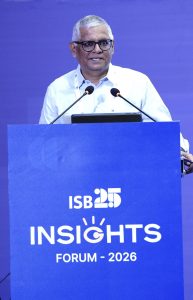
In his opening remarks, ISB Dean Prof. Madan Pillutla recalled the founders’ vision of establishing a research-led business school focused on India’s challenges with global academic rigour.
He said the forum provided an opportunity to share ongoing research and understand the priorities of policymakers and industry decision-makers.
Prof. Karthik Balakrishnan, Deputy Dean, Faculty and Research, ISB, emphasised that the strength of a research ecosystem depended on quality rather than quantity. Research should be sufficiently rigorous to inform practical decisions, and its relevance should be assessed over time rather than through short-term outcomes, he said.
The forum featured six panel discussions involving ISB faculty, industry representatives and policy experts.
Discussions covered the geopolitics of AI, AI and financial innovation, business models for improving livelihoods, policymaking during economic crises, factors influencing women’s career advancement and operational models to maximise the impact of community health workers.
The sessions examined issues including cross-border technology regulations, financial inclusion, market competition, grassroots livelihoods, responses to economic shocks, workplace opportunities for women and improving frontline healthcare delivery.