NIT Rourkela Researchers Secure Patent for Smart EV Charging Technology
The technology addresses key challenges associated with EV charging infrastructure, including sudden increases in electricity demand, fluctuations in solar power generation and reduced battery life due to repeated charging and discharging cycles, the Institute said in a release.
The research team comprising Prof. Pravat Kumar Ray, Professor, Prof. Arnab Ghosh, Associate Professor, and Dr. Anindya Bharatee, Research Graduate, from the Electrical Engineering Department, developed a solar-powered EV charging microgrid integrating solar panels, the conventional electricity grid and an energy storage system combining batteries and supercapacitors.
The patent was granted for the technology under application number 202531101758, dated October 22, 2025.
The system uses an improved mixed droop control technique to ensure stable power sharing between batteries and supercapacitors, thereby enhancing the overall reliability and efficiency of the charging infrastructure.
While batteries handle sustained electricity demand, supercapacitors respond to sudden fluctuations by absorbing and releasing energy rapidly.
This arrangement reduces stress on batteries and helps extend their operational life.
The technology also manages electrical voltage, regulates power supplied for EV charging based on battery charge levels and controls the flow of electricity from vehicles back to the grid through Vehicle-to-Grid (V2G) operations.
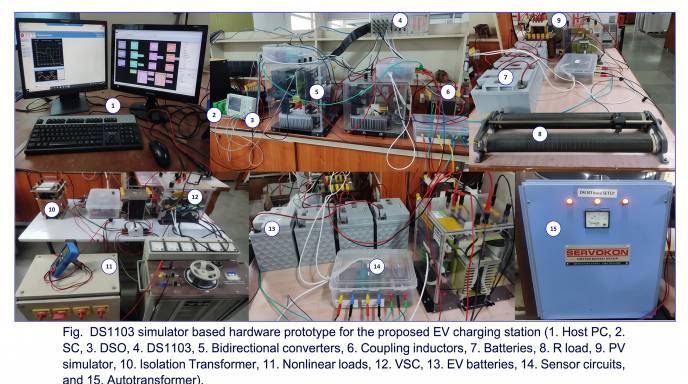
The research team has developed a prototype and tested it under simulated variations in solar power generation and electricity demand.
Prof. Pravat Kumar Ray said the integration of batteries and supercapacitors would help address fluctuations in electricity demand while protecting batteries from excessive current variations.
Prof. Arnab Ghosh said the team planned to scale up the prototype for higher-power EV charging systems by integrating advanced battery management and energy optimisation algorithms.
The researchers also proposed exploring grid-forming control, multiple EV integration and real-time field trials to develop an industry-ready solution.
The technology could be deployed in residential, commercial, institutional and public EV charging facilities, supporting both Grid-to-Vehicle (G2V) and V2G operations.
The development comes amid the country’s efforts to expand electric mobility, reduce dependence on crude oil imports and address environmental concerns.