India Develops 75 Lighthouses as Tourism Destinations, Visitor Numbers Reach 18.63 Lakh




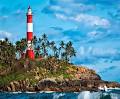
Lighthouses developed as tourism destinations include Mandvi and Dwarka in Gujarat, Tadri in Karnataka, Pamban in Tamil Nadu and Vizhinjam in Kerala.
A digital ticketing portal launched by the Directorate General of Lighthouses and Lightships (DGLL) has also streamlined access for visitors.
The growing interest in lighthouse tourism is generating economic opportunities for local hotels, restaurants, tour operators, transport services, shops and artisans.
Modernisation of navigation systems
All lighthouses in the country are solar-powered, integrating renewable energy into maritime navigation infrastructure.
Traditional oil lamps and older lighting systems have gradually given way to solar-powered electronic flashers and LED lanterns.
At Samiyani Island in Gujarat, an oil lamp was replaced by a solar-powered electronic flasher, followed by an LED lantern in 2016. At Jodiya, a solar-operated flashing light was upgraded to a high-intensity LED lantern in 2021.
Additionally, 87 Automatic Identification System (AIS) shore stations have been installed on lighthouses along the coast.
AIS facilitates the exchange of vessel-related information and helps improve navigational safety, situational awareness and shipping traffic management.
Museums preserve maritime heritage
Dedicated lighthouse museums have been established at Chennai, Mahabalipuram, Alappuzha, Kannur, Muttom, Dwarka and Gopnath to showcase the history and architectural significance of lighthouse infrastructure.
Mahabalipuram, also known as Mamallapuram, has a maritime history dating back to the seventh century AD, when the Pallavas developed it as a port for trade with Southeast Asia and the Mediterranean region.
A log fire was initially used to guide vessels approaching the coast.
The first conventional lighthouse was established in 1887 on the roof of Olakkaneeswar Temple, using a wick lamp fitted inside a fourth-order optic and lantern. Its lighting system was subsequently modified, and the main light was upgraded to a 236-watt LED array in 2020.
The present lighthouse is a 26-metre-high circular stone masonry tower. Its museum houses exhibits and artefacts highlighting the evolution of lighthouses and India’s maritime history.
Lothal to house Lighthouse Museum
The National Maritime Heritage Complex (NMHC) at Lothal in Gujarat is planned to include a 77-metre-high Lighthouse Museum at an estimated cost of Rs 266.11 crore.
The complex aims to showcase India’s maritime heritage spanning more than five millennia.
Other proposed facilities include a 5D Dome Theatre, Coastal States Pavilion, Museotel, Eco Resort and Maritime Research Institute, being developed in association with the Indian Maritime University.
The museum’s design draws inspiration from the Mahabalipuram Lighthouse and will incorporate virtual reality walkthroughs showcasing lighthouse history along India’s coastline.
A sound-and-light show using projection mapping technology is also planned.
A separate Lighthouse Museum is proposed near the Old Lighthouse area in Visakhapatnam, where 3,156 square metres of land have been earmarked for the project.
Lighthouse festivals promote coastal culture
The Indian Lighthouse Festival was first held at Fort Aguada in Goa in 2023, followed by Puri in Odisha in 2024 and Visakhapatnam in 2026.
The festivals feature cultural exhibitions, sessions on maritime history, classical performances, musical programmes and coastal cuisine.
The Puri edition highlighted five tourism-developed lighthouses in Odisha — Gopalpur, Puri, Chandrabhaga, Paradip and False Point — through programmes featuring sand art, boat art, yoga and folk performances.
The events also seek to involve coastal communities in preserving and promoting lighthouse sites. The Visakhapatnam edition featured local crafts, coastal cuisine and night-time illumination, while a light-and-sound projection mapping show has been introduced at Fort Aguada.
Expansion to inland waterways
Another 25 lighthouses have been proposed for development as tourism destinations, expanding the existing network of 75 sites.
Four lighthouses are also being established along the Brahmaputra at Pandu, Bogibeel, Silghat and Biswanath Ghat, marking India’s first lighthouse infrastructure on an inland waterway.
The projects have a combined outlay of around Rs 84 crore, with each lighthouse planned to be 20 metres high and equipped with solar power and weather-observation sensors.
The sites will also feature museums, amphitheatres, cafeterias, children’s play areas, souvenir shops and landscaped public spaces.
The initiatives aim to strengthen navigational infrastructure while promoting tourism, preserving maritime heritage and creating economic opportunities for communities around lighthouse sites.