Hyd: 34-Year-Old Man Walks Again After Three Years Following Complex Surgery
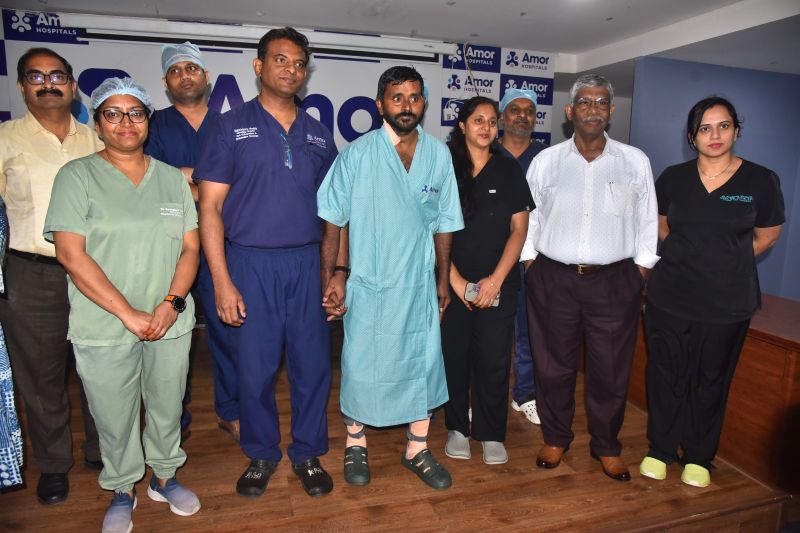
Hyderabad, Aug 8 (TNT): A 34-year-old man who had been bedridden for nearly three years following a severe traumatic brain injury has regained the ability to stand and walk with assistance after undergoing complex reconstructive orthopaedic surgery at Amor Hospitals.
The patient had sustained a critical head injury in a road accident three years ago and underwent multiple life-saving neurosurgical procedures.
Though his life was saved, he subsequently developed severe deformities in both lower limbs, leaving him unable to stand or walk independently, the hospitals said in a release here on Saturday.
Clinical evaluation found Neurogenic Heterotopic Ossification (HO) in both hips, a rare complication following severe brain injury in which abnormal bone forms in muscles and soft tissues.
The condition, along with severe contractures of the hips, knees and ankles, had effectively restricted movement of his lower limbs.
A multidisciplinary orthopaedic team at Amor Hospitals planned and performed a staged reconstructive surgery. The procedure was carried out on the right leg on July 21 and the left leg on July 27.
Following the surgery, the patient regained an upright posture and functional weight-bearing ability and is now able to walk with assistance for the first time in nearly three years.
He is currently undergoing rehabilitation, including specialised physiotherapy and gait training, to improve his strength, balance and functional independence.
Dr Kishore B Reddy and team, Orthopaedic Surgeon, Amor Hospitals, who led the surgical team, said neurogenic heterotopic ossification was a challenging complication following severe brain injury as abnormal bone formation could completely immobilise joints.
The case required meticulous surgical planning and a staged approach to remove the abnormal bone and correct multiple joint contractures, he said.
The successful outcome highlights the role of specialised orthopaedic reconstruction and comprehensive rehabilitation in managing complex post-traumatic disabilities, the hospital said.
It also demonstrates that patients with prolonged immobility may regain meaningful functional ability following appropriate surgical intervention and structured rehabilitation.
TNT TS